The Ha Giang Loop is one of northern Vietnam’s most rewarding road journeys, but it is not simply a checklist of famous viewpoints. The best experience comes from matching the route to your riding confidence, allowing time for weather and road conditions, and treating the mountain communities along the way with respect. This practical guide explains how to plan a Ha Giang Loop itinerary, what to see between Ha Giang City and Dong Van, and how to make the journey safer and more memorable.
What makes the Ha Giang Loop special?
Ha Giang’s appeal is the constant change in the landscape. Roads climb from river valleys into limestone mountains, then descend through narrow gorges and small settlements. The official Vietnam Tourism destination guide describes the area as a rugged highland best experienced on two wheels, with Ma Pi Leng Pass, the Nho Que River, Quan Ba, Sa Phin and Lung Cu among the standout experiences. That variety is why the Ha Giang Loop works for adventurous travellers who want scenery, local encounters and a genuine sense of movement rather than a single attraction.
The route also rewards a slower pace. A short stop for coffee, a conversation at a homestay or a walk through a village can be as memorable as a dramatic pass. If this is your first northern Vietnam trip, start with the broader advice in this first-timer’s guide to Northern Vietnam adventures, then use the sections below to shape a route that fits your group.
How many days do you need?
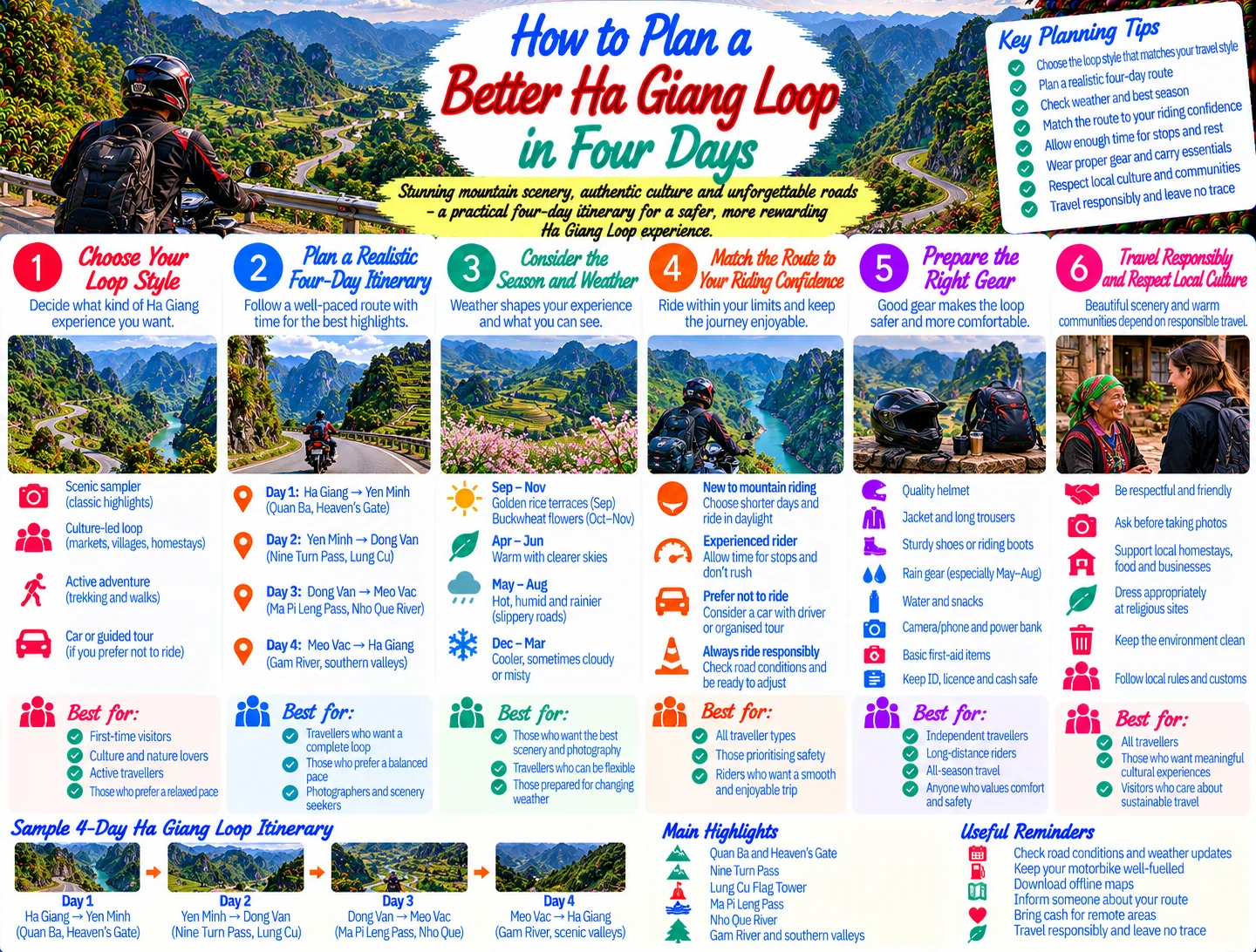
A four-day Ha Giang Loop itinerary is a useful benchmark because it gives you time to travel through the main mountain corridor without treating every day as a race. Vietnam Tourism’s published four-day outline runs from Ha Giang City towards Yen Minh, Dong Van and Meo Vac before returning through Bao Lam and Bac Me. It is a planning framework, not a requirement: weather, road repairs, riding ability and the time you want to spend walking may all justify adding a night.
Choose your pace
- Three days: possible for experienced riders with an early start and fewer detours, but demanding if conditions are wet or visibility is poor.
- Four days: the most balanced option for seeing the major mountain scenery while leaving room for stops.
- Five or more days: better for travellers who want village walks, longer meals, a rest day or a less hurried return.
Do not judge the route by distance alone. Mountain curves, photo stops and changing surfaces make a modest number of kilometres feel like a full day. Build flexibility into the final afternoon instead of booking a tight onward connection immediately after returning to Ha Giang City.
A practical Ha Giang Loop itinerary
Day 1: Ha Giang City to Quan Ba and Yen Minh
Leave Ha Giang City in daylight and use the first morning to settle into the rhythm of mountain riding. The road rises towards Quan Ba and Heaven’s Gate, where the scenery changes quickly from town edges to limestone peaks and valleys. Continue towards Yen Minh, pausing for food, fuel and short walks rather than trying to reach every viewpoint.
This first section is also a useful confidence check. If the bends, traffic or weather feel more challenging than expected, adjust the next day rather than assuming the route will become easier. A host or local travel company can help you identify a comfortable homestay and realistic stopping points; Vietnam Tourism notes that popular accommodation can fill during busy periods.
Day 2: Yen Minh to Dong Van, with Sa Phin and Lung Cu
North of Yen Minh, the landscape becomes more exposed, with eroded limestone and high passes creating long views across the plateau. The Nine Turn Pass is a natural place to stop, but the most important part of the day is leaving enough time for the side trip to Lung Cu if you choose to make it. Vietnam Tourism’s route guide treats the flag tower as a substantial detour, so do not add it casually to an already late schedule.
Sa Phin is another worthwhile pause, especially for travellers interested in local history and architecture. Arrive in Dong Van with time to walk rather than only checking in and eating. Ask your host about the local market schedule because market days and times should be confirmed locally rather than assumed from an old itinerary.
Day 3: Dong Van, Ma Pi Leng Pass and Meo Vac
The road between Dong Van and Meo Vac is the visual high point for many riders. Ma Pi Leng Pass follows a dramatic line above the Nho Que River, with huge limestone walls and deep valleys below. Take the pass slowly, pull over only where it is safe, and allow time for views instead of trying to photograph every bend.
If conditions and timing allow, a side road near the bottom of the pass offers a closer perspective on the Nho Que valley. Treat this as an optional addition. A detour is only worthwhile when you can return before dark and still arrive at your overnight stop without rushing. Meo Vac is a good place to pause, eat and reset after a visually intense morning.
Day 4: Meo Vac or Bao Lam back to Ha Giang City
The return route through Bao Lam and Bac Me has a different character from the limestone passes. River valleys and quieter stretches create space to reflect on the journey, but the day still includes curves and changing conditions. Start early, carry enough water and food for the less built-up sections, and leave margin for construction or an unplanned stop.
How to choose between riding, an easy rider and a tour
Riding your own motorbike offers the greatest freedom, but freedom is useful only when you have the skills and confidence to use it. You should be comfortable with slow-speed control, braking on descents, tight bends, changing surfaces and riding defensively around other traffic. Vietnam Tourism advises approaching curves cautiously, travelling during daylight and stopping after dark; those are practical rules, not optional extras.
An easy rider arrangement can suit travellers who want the scenery without carrying the full responsibility of navigation and mountain riding. A guided tour may be preferable for solo visitors, nervous riders or groups with limited route-planning experience. Before booking, clarify the group size, daily riding hours, accommodation style, luggage arrangements, weather policy and what is included. Do not select an operator solely because its itinerary lists the most stops.
For a broader approach to vehicle preparation and responsible road travel, see this guide to planning a Northern Vietnam road trip responsibly. The principles of realistic timing, daylight travel and respect for local roads apply especially strongly in Ha Giang.
Safety and comfort on the mountain roads
Ride for conditions, not the itinerary
Rain can reduce visibility and make surfaces slippery, while mist can hide the shape of a bend. Vietnam Tourism describes the roads as generally usable but warns that obstacles and construction can appear at any time. Slow down before corners, keep a generous following distance and do not stop in the middle of a curve for a photograph.
Pack for a changing climate
Bring a waterproof layer, warm clothing for exposed passes, gloves, sun protection and footwear that works for short walks. Keep electronics and documents in a dry bag. Carry cash because the official route guide warns that ATMs become scarce outside Ha Giang City. A small first-aid kit, water and snacks are sensible additions even when you expect regular meals.
Protect your energy
Mountain travel is tiring because concentration matters for hours at a time. Eat before long sections, take breaks before you feel exhausted and avoid riding after dark. If one member of the group is struggling, shorten the day. A flexible itinerary is safer and usually more enjoyable than pushing on to preserve a booking.
Travellers who want more general trail and outdoor preparation can also consult this practical guide to a safer day on a mountain trail. Ha Giang is a road trip first, but many of its best moments begin when you park and walk.
Where the cultural experience fits into the route
Ha Giang is not an empty backdrop for a motorbike video. It is home to long-established communities, working farms, markets and family-run accommodation. Travel with curiosity rather than entitlement: ask before photographing people, follow household rules at homestays, dress respectfully in village settings and buy directly from local businesses when you can.
Markets are especially valuable when approached as community events rather than staged attractions. Ask your host which market is operating during your stay and what time is appropriate. In a homestay, learn how meals work, avoid wasting food and remember that a few Vietnamese greetings can make interactions warmer even when conversation is limited.
Responsible choices also include managing rubbish, carrying a refillable bottle where practical and avoiding damage to roadside plants, terraces or rock formations. The site’s National Parks & Wildlife category offers more context on visiting northern Vietnam’s natural places with care, while the Motorbike & Road Trips category is useful for comparing road-focused planning ideas across the region.
When should you visit Ha Giang?
Vietnam Tourism highlights September to November for golden rice terraces and buckwheat flowers, while also describing Ha Giang as cool through the year and warning that roads can be wet and slippery from May to August. These are useful seasonal signals, not guarantees. Conditions vary by elevation and by year, so check a current forecast close to departure and ask local hosts about the road ahead.
Autumn can be popular because of landscape colour and more comfortable riding temperatures. Other months may offer quieter roads or a different atmosphere, but you should be prepared for heat, cold, rain or mist depending on the route. Choose dates based on the experience you want and your ability to adapt, not on a promise that every field will look the same as a photograph.
What to confirm before you leave Ha Giang City
- Check the bike’s brakes, tyres, lights, horn, mirrors and fuel level.
- Confirm where you will sleep and whether the host can advise on current road conditions.
- Download offline maps, but treat them as backup rather than a substitute for local advice.
- Pack light enough to keep the bike stable and protect valuables from rain.
- Tell someone your broad route and expected return date.
- Keep the first day conservative so you can adjust the rest of the loop with confidence.
Also decide what a successful trip means for your group. It might be reaching Ma Pi Leng, sharing a meal in a homestay, walking through a quiet valley or simply completing the route without rushing. That definition will produce a better Ha Giang Loop itinerary than a long list of forced photo stops.
Final thoughts
The Ha Giang Loop is at its best when the road trip remains open to the mountains around it. Use the four-day route as a framework, choose transport that matches your experience, travel in daylight and leave room for weather, conversations and unexpected beauty. With realistic planning and respect for local communities, Ha Giang becomes more than a famous motorbike route: it becomes a thoughtful journey through one of northern Vietnam’s most powerful landscapes.
JOIN THE CONVERSATION
Comments (0)
No comments yet. Be the first to share a thought.