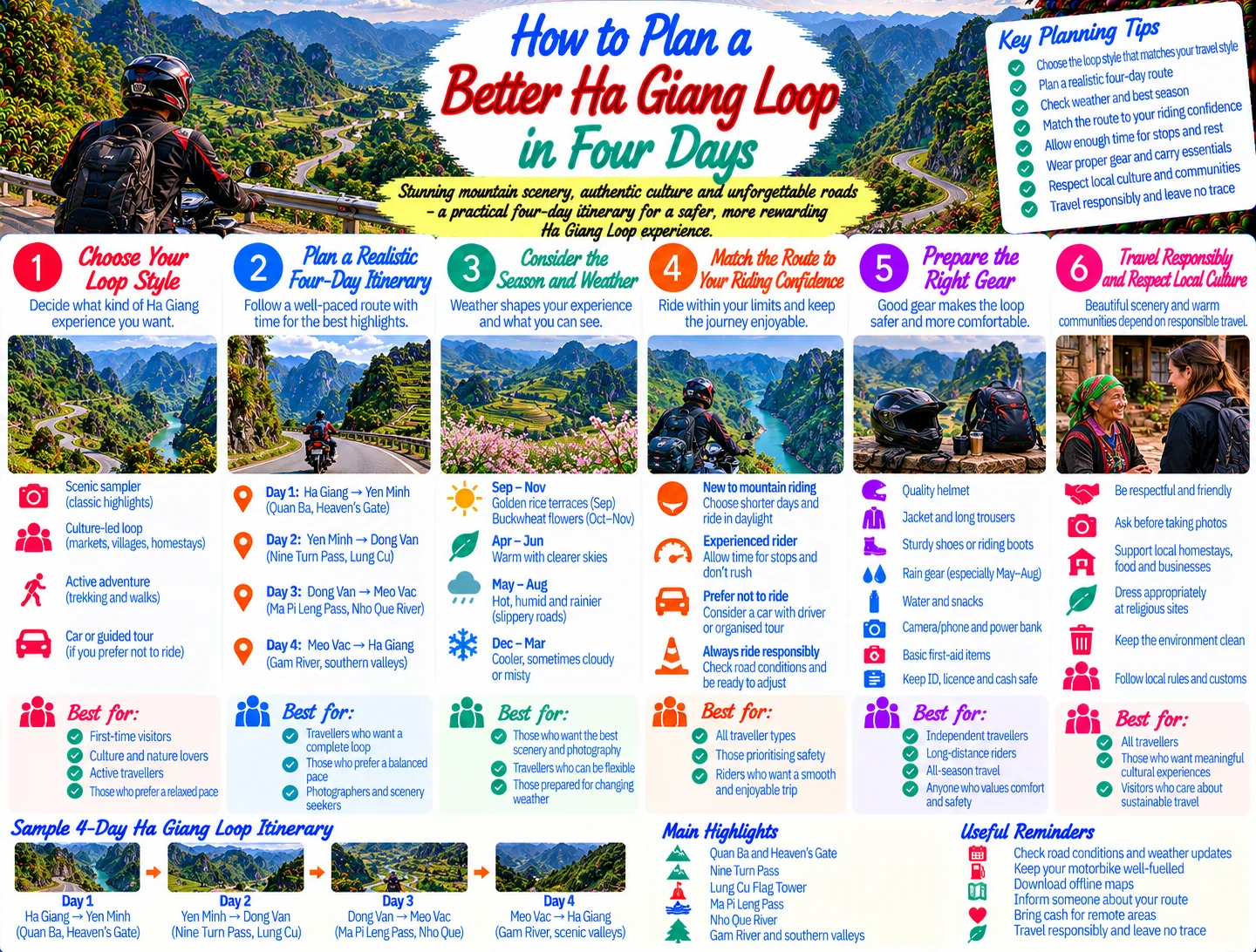
The Ha Giang Loop is not one fixed experience. It can be a rewarding four-day road trip, a rushed sequence of viewpoints, or an uncomfortable ride if the route is matched badly to your time, confidence, and weather. This practical guide helps you plan a Ha Giang motorbike loop around the kind of journey you actually want: scenic, cultural, active, or deliberately unhurried.
Start by choosing your Ha Giang loop style
Before choosing stops, decide what “a good loop” means for you. The official Vietnam Tourism guide describes Ha Giang as a road-trip destination best experienced on two wheels, while also noting that mountain weather and road conditions can change the character of a journey. That makes pacing more important than collecting every famous viewpoint.
The scenic sampler
If this is your first northern Vietnam road trip, prioritize the classic mountain corridor: Ha Giang City, Quan Ba, Yen Minh, Dong Van, Ma Pi Leng Pass, Meo Vac, and the return south. You will see limestone peaks, high passes, valleys, and villages without adding every possible detour. This is the best fit for travelers who want a clear first impression and enough time to stop for photographs.
The culture-led loop
Choose this style if markets, homestays, local food, and slower conversations matter as much as dramatic roads. Keep overnight stops flexible, ask hosts about market dates and times, and leave room for a village walk. A route that looks shorter on a map may take much longer when you stop respectfully rather than treating communities as scenery.
The active adventure
For trekking, short walks, and viewpoint climbs, reduce the number of riding hours. Ha Giang offers opportunities beyond the saddle, including walks around karst landscapes and rural settlements. If you plan to hike, build in daylight, footwear, water, and recovery time instead of assuming every day can be both a long ride and a full trekking day.
Build a realistic four-day route
Vietnam Tourism’s published four-day outline follows the QL4C northeast from Ha Giang toward the high plateau and then returns by QL34 from Bao Lam toward Ha Giang. Use that structure as a planning framework, not a promise that every traveler should copy it exactly.
Day one: Ha Giang City to Yen Minh
Use the first day to settle into the rhythm of mountain riding. Quan Ba and Heaven’s Gate are natural early milestones, but the value of the day is learning how long climbs, curves, meal stops, and photo breaks take. Reaching Yen Minh with energy left is more useful than forcing a late arrival at a more distant town.
Day two: the northern border landscape
The road toward Dong Van becomes increasingly dramatic, with steep limestone scenery and the Nine Turn Pass. Lung Cu Flag Tower is a substantial detour in the official itinerary, so decide in advance whether the border viewpoint is central to your trip. If it is, shorten another stop rather than adding the detour after dark.
Day three: Dong Van, Ma Pi Leng, and Meo Vac
This is usually the emotional high point of a Ha Giang itinerary. The road between Dong Van and Meo Vac crosses the Ma Pi Leng area, where deep valleys and huge rock faces make frequent stops tempting. Treat the pass as a slow scenic section, not a distance to be conquered. A short side road toward the Nho Que River can add variety, but only if your conditions, fuel, and daylight allow it.
Day four: return through the southern valleys
The return toward Ha Giang is not merely a transfer day. The route along the Gam River offers a different view of the region and can feel calmer after the high passes. Keep your final arrival flexible; you may want time to return a motorbike, catch onward transport, or rest before continuing to Hanoi.
Match the route to your riding confidence
A Ha Giang motorbike loop rewards attention rather than speed. Even confident urban riders may find mountain curves, changing surfaces, livestock, and passing traffic unfamiliar. Your route should reflect the rider you are in these conditions, not the rider you imagine becoming on holiday.
If you are new to mountain riding
Choose a shorter first day, ride in daylight, and avoid treating a map estimate as a timetable. Practice braking and cornering before the road becomes steep. Keep your eyes beyond the immediate bend, slow before curves rather than in them, and stop only where you can pull fully clear of traffic.
If you are an experienced rider
Experience gives you more options, not permission to rush. Leave margin for construction, weather, slow vehicles, and unplanned stops. The best stretches of the loop are visually distracting, so schedule breaks rather than repeatedly stopping in unsafe places. If the road is wet or visibility falls, change the day’s target.
If you prefer not to ride
Consider a car with a driver or an organized small-group trip. You can still enjoy the landscapes, villages, markets, and walking opportunities without making riding the central skill of the holiday. Ask exactly how much time is spent on the road, where you will sleep, and whether the itinerary allows genuine stops rather than only roadside photographs.
Plan for weather, daylight, and road conditions
The official destination guide identifies September to November as a strong seasonal window: rice terraces turn golden in September and buckwheat flowers generally bloom from October to November. It also describes a cool mountain climate, colder winters, and wetter, more slippery roads from May to August. These are useful planning signals, not guarantees for every day.
In a wet period, reduce daily distance and make waterproofing part of the plan. Keep a dry layer, protect documents and electronics, and check the next day’s route with your host. In cooler months, start later if morning conditions are poor, but do not let a late departure push you into night riding. Weather is a reason to build flexibility into the loop, not a reason to delete all stops before you arrive.
Keep the first and last riding hours conservative.
Use daylight as a firm boundary for exposed mountain roads.
Allow extra time for construction, traffic, and weather-related pauses.
Ask locally about the next section before committing to a detour.
For a broader preparation checklist, read Planning a Northern Vietnam Road Trip Responsibly. It pairs naturally with this destination-specific plan because it focuses on the decisions that make a road trip safer and more considerate.
Choose stops that add meaning, not just mileage
Ha Giang is easy to reduce to a chain of famous names. A better itinerary gives each stop a purpose. Quan Ba can be a viewpoint and a gentle introduction to the karst landscape. Dong Van can be an overnight base for a market, meal, or morning walk. Ma Pi Leng can be a landscape experience where you slow down. Sa Phin’s H’Mong King Palace offers a historical stop near the northern route, while Lung Cu adds a borderland perspective for travelers willing to devote the time.
Use local markets thoughtfully. The official four-day guide recommends checking dates and times with your host rather than assuming a market is operating whenever you arrive. That small conversation can prevent a long detour for a closed or quiet morning, and it gives you a better chance of visiting without turning the market into a staged attraction.
Balance highlights with ordinary pauses: a bowl of breakfast before departure, coffee in a town, a walk near your homestay, or an early night after a demanding pass. These moments make the loop feel like travel rather than a checklist.
Pack for a remote mountain road trip
The official route guide warns that resources become limited outside Ha Giang City and recommends carrying enough cash because ATMs are scarce. Treat that as a planning principle: arrange access to money before leaving the city, and do not assume every small stop will accept the payment method you use at home.
Useful categories to cover
Layered clothing and rain protection for changing mountain conditions.
Closed shoes with enough grip for short walks and wet surfaces.
A small day bag, water, snacks, and personal medication.
Offline access to your accommodation details and route notes.
Secure storage for passport, cash, phone, and essential documents.
A charging plan that does not depend on finding a café at every stop.
Keep luggage compact. A heavy bag affects comfort and stability, especially when roads are uneven or you need to move it between a motorbike, car, and homestay. Ask your rental provider or driver what is included rather than assuming roadside support, protective equipment, or luggage storage.
Make the loop more responsible
Responsible travel in Ha Giang begins with treating the mountains and communities as places where people live, not as a backdrop built for visitors. Ask before photographing people, especially children. Buy from local businesses when practical, keep waste with you until you find a suitable bin, and avoid entering homes, fields, or sacred spaces without an invitation.
Respectful travel also means choosing an itinerary you can complete safely. Speeding, night riding, and forcing a pass in poor weather create risks for you and for everyone sharing the road. If you hire a rider, choose a service that explains the plan clearly and gives you a realistic chance to rest. If you ride yourself, do not let social media itineraries pressure you into a pace that does not fit your experience.
The site’s guide to visiting Northern Vietnam’s wild places with care offers a useful wider perspective on low-impact decisions. You can also browse the National Parks & Wildlife category when you want to extend the trip beyond roads and viewpoints.
Connect Ha Giang with the rest of your trip
Ha Giang works best when it is given enough space in a northern Vietnam itinerary. Avoid placing a demanding loop between two immovable same-day connections unless you have a generous buffer. A rest night before departure can make the first riding day more enjoyable, while a quiet night afterward helps you recover before Hanoi or another destination.
If you are comparing different landscapes, the site’s Mountain Trekking & Hiking category can help you contrast road-based adventure with walking-focused days. For a broader introduction to planning the region, see A Practical First-Timer’s Guide to Northern Vietnam Adventures. These links are useful starting points, but the final decision should remain your own: choose the route that leaves enough time for safety, people, weather, and unplanned beauty.
Conclusion: plan the Ha Giang loop you can enjoy
The best Ha Giang Loop itinerary is not the one with the most stops. It is the one that matches your riding confidence, protects daylight, leaves room for weather, and gives the landscape and communities your attention. Start with a clear style of trip, use the four-day route as a flexible framework, and reduce distance whenever the conditions call for it. With that approach, Ha Giang becomes more than a dramatic road: it becomes a thoughtful mountain journey you can remember for the right reasons.
JOIN THE CONVERSATION
Comments (0)
No comments yet. Be the first to share a thought.