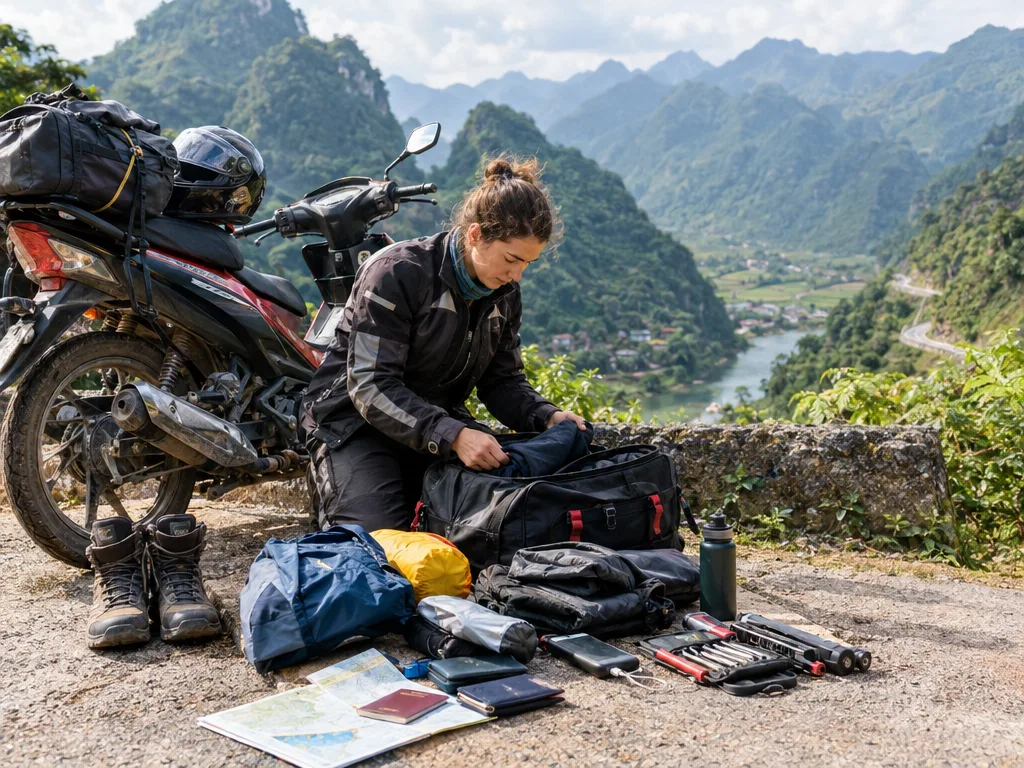
A Northern Vietnam motorbike packing list should do more than fill a bag. It should help you stay warm on high passes, visible on winding roads, comfortable during long days, and prepared for a sudden change in mountain weather. The most useful approach is to pack light, divide essentials between you and the bike, and leave room for local stops rather than planning every kilometre.
Start with the riding conditions, not the destination name
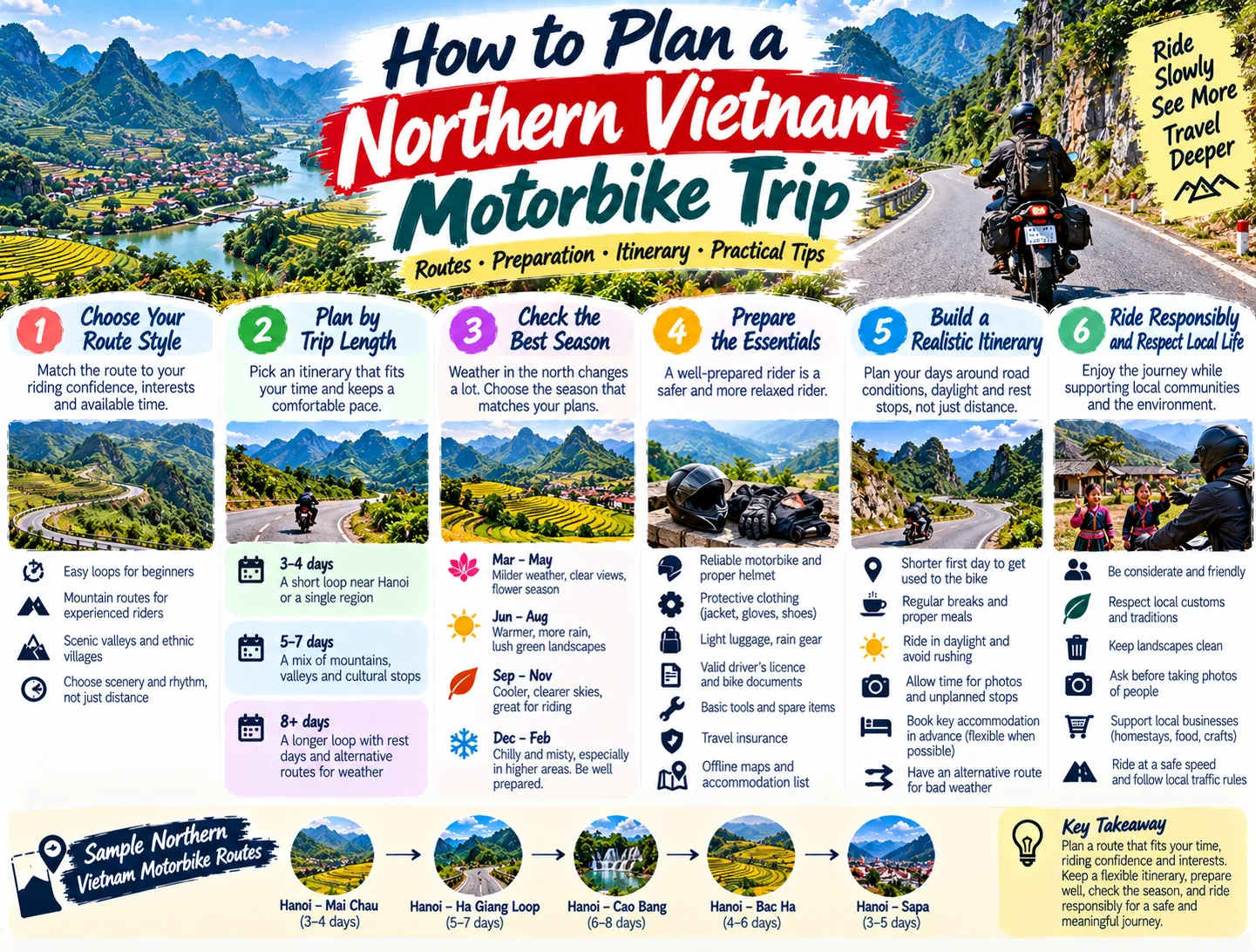
Mountain riding in Northern Vietnam is different from a city commute. The Ha Giang Loop crosses Quan Ba, Yen Minh, Dong Van and Meo Vac, with high passes, tight curves and deep valleys. Vietnam’s official tourism guidance describes the route as scenic but demanding, so your packing should support concentration rather than create extra weight. Think in terms of a cool morning, a warmer valley, a wet afternoon and a darker return than expected.
The Dong Van Karst Plateau is also a landscape where geology, culture and local livelihoods meet. UNESCO’s guidance on Global Geoparks emphasises protection, education, sustainable development and community involvement. That makes a respectful road-trip kit practical as well as ethical: reusable water storage, modest clothing for village visits and a way to carry rubbish are small choices that reduce pressure on the places you pass through.
The core Northern Vietnam motorbike packing list
Documents and money
- Passport and any required travel documents, stored in a waterproof pouch.
- Copies or secure digital backups of important documents, kept separately from the originals.
- Small amounts of Vietnamese dong for rural stops, with a backup payment method stored away from your daily wallet.
- Emergency contact details and your accommodation information written down, not only stored on a phone.
Before leaving, confirm the rental company’s documentation requirements and what support is available if the bike develops a problem. Do not assume that a copy, an international licence or insurance arrangement is accepted simply because another traveller used one. Ask the provider to explain the relevant requirements in writing and keep the agreement accessible offline.
Clothing for changing elevations
- A breathable base layer that dries quickly.
- A light insulating layer for early starts and exposed passes.
- A waterproof outer shell with a hood that fits under or over your helmet comfortably.
- Light trousers or riding trousers; avoid loose fabric that can catch on controls.
- Gloves with grip, plus a thin spare pair if rain is likely.
- Warm socks and one dry change of clothes sealed in a bag.
- Closed shoes with secure soles, ideally footwear that works for short walks as well as riding.
Use layers instead of one heavy jacket. The route can move between sunny valleys and cooler, windy viewpoints, while rain can make clothing feel colder than the temperature suggests. Pack one complete dry riding set in a waterproof liner rather than spreading all your clothes through the luggage.
Protection and comfort on mountain roads
Helmet, visibility and weather protection
Choose a helmet that fits securely and leaves enough room for your ears and eyewear without shifting. A clear visor is useful in low light and rain; sunglasses are helpful in glare but should not replace a clear option. Add a reflective layer or bright rain cover if your outer clothing is dark. Keep the visor clean, because dust and spray become tiring when roads curve continuously.
Pack a compact neck gaiter or buff, sunscreen, lip balm and eye protection. These items are easy to overlook, yet wind, dust and strong sun can make a long riding day much harder. A small microfiber cloth is useful for wiping a visor, phone screen or mirror without using a shirt sleeve.
First-aid and personal essentials
- Plasters, blister protection, antiseptic wipes and medical tape.
- Any regular medication in its original packaging, plus a little extra for delays.
- Hand sanitiser, tissues and a small rubbish bag.
- Personal toiletries in travel sizes.
- Water and simple snacks that will not melt or crumble through your luggage.
Keep first-aid items where you can reach them without unpacking the whole bike. This is not a substitute for travel insurance or professional medical advice. It is simply a way to deal with minor discomforts before they interrupt the day.
Bike tools, navigation and power
A small repair kit
Ask the rental provider what is already supplied and check the bike before departure. Useful additions may include a basic tool kit, tyre-puncture supplies appropriate to the bike, spare charging cable, cable ties, duct tape and a small torch. Do not carry tools you do not know how to use; instead, learn how to check tyre condition, chain appearance, fuel level, lights and brakes during the handover.
Photograph the bike from several angles before riding away and record existing marks with the provider. This is good rental practice and helps you focus on the journey rather than disputes at the end.
Offline navigation and communication
- Download maps for the route and save accommodation names in Vietnamese where possible.
- Carry a power bank and keep one charging cable as a spare.
- Use a secure phone mount only if it does not obstruct controls or your view.
- Save the phone numbers of your rental provider, accommodation and a trusted local contact.
- Tell someone your broad route and expected arrival area, especially on a multi-day loop.
Use navigation while stopped, not while moving through a bend. A printed or handwritten route outline is useful when signal, battery or weather makes a screen unreliable. Build in time to ask locally rather than treating the fastest digital route as the safest route.
Pack for a realistic riding day
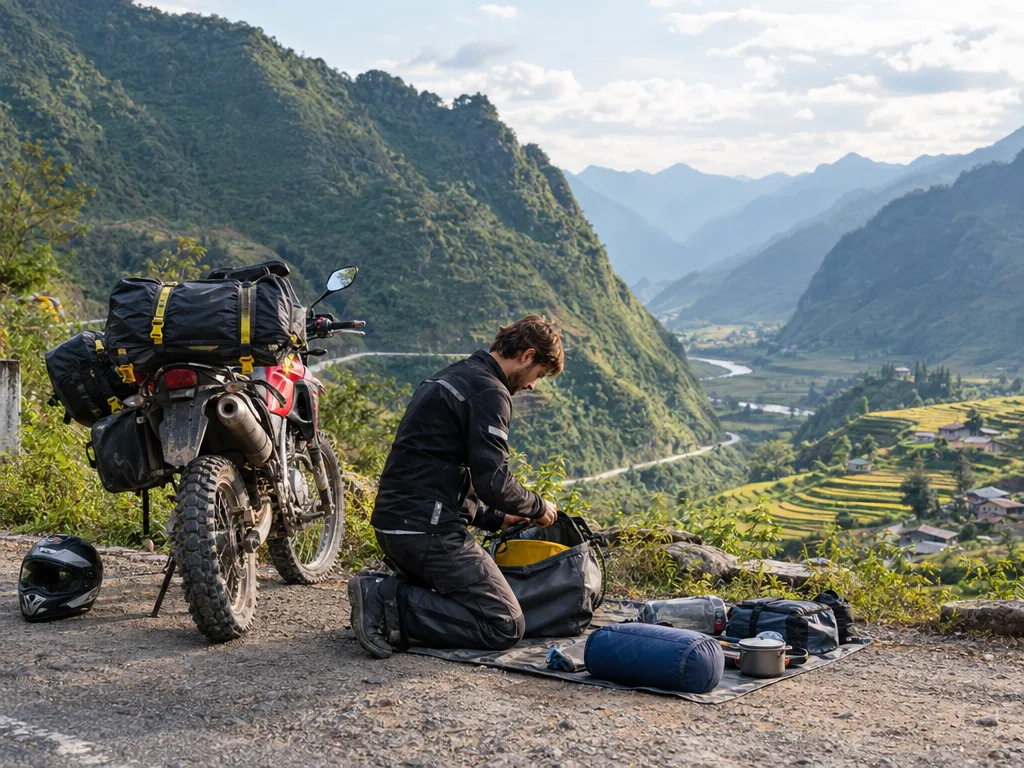
A common mistake is planning around the distance shown on a map. Mountain roads include bends, climbs, photo stops, weather pauses, meals and slower traffic. Pack the items you need during the day in an accessible top layer: rain shell, water, snacks, phone, documents and a warm layer. Put spare clothes and less-used items lower down, protected from rain and dust.
Use two or three small waterproof bags inside the main luggage rather than one large sack. One can hold clothing, one electronics and documents, and one food or personal items. This makes it easier to find essentials at a homestay without emptying every bag onto the floor.
A practical daily check
- Can you reach your rain layer before the weather changes?
- Are your documents and phone protected from water?
- Is the load balanced and secured so it cannot touch the wheel or exhaust?
- Do you have enough water for the next stretch without assuming a shop will appear?
- Have you checked fuel, tyres, lights, brakes and mirrors?
- Does someone know where you are heading today?
What not to pack
Leave behind hard-sided cases that shift the bike’s balance, excessive denim, fragile valuables, multiple pairs of shoes and large bottles that add weight. Avoid tying loose straps where they can catch on moving parts. A bulky camera kit can also become a burden if the trip is primarily about riding; choose one protected device and use short stops for photographs.
Do not pack your itinerary so tightly that every delay becomes a crisis. The official tourism description presents the Ha Giang route as a road trip through several districts and notable viewpoints, not as a race between fixed checkpoints. A flexible plan gives you more room to stop safely, change layers, eat locally and respond to weather.
Responsible packing for villages and protected landscapes
Pack modest, adaptable clothing for entering homes or visiting communities, and ask before photographing people. Carry reusable water storage and bring rubbish back to a place with suitable disposal. Avoid taking rocks, plants or cultural objects from the landscape. Choose locally owned accommodation and services where possible, and listen when a host or guide explains a local custom.
UNESCO’s description of geoparks connects geological heritage with natural, cultural and intangible heritage. On the road, that principle can become simple behaviour: stay on established routes, keep noise low near homes, do not disturb livestock, and treat viewpoints as shared places rather than private photo studios.
Choose luggage that stays stable
Your luggage should remain secure when the road becomes uneven and should not force you to lean or twist. Soft panniers, a tail bag or a compact waterproof duffel can work when fitted correctly, but the best choice depends on the rental bike and its existing rack. Ask the provider to demonstrate the attachment points before you leave. Check that straps cannot reach the chain, wheel, brake or exhaust, and recheck them after the first short ride.
Keep heavier items low and close to the centre of the bike. Do not put all weight on one side, even if that side seems easier to access. If you carry a camera, laptop or other fragile object, wrap it against vibration and avoid placing it where a fall would make the bike unsafe to handle. A small dry bag for documents and electronics is often more valuable than a larger bag with many separate compartments.
Make rain protection easy to use
Rain covers hidden at the bottom of a bag are not much help when a shower arrives on a pass. Store the cover, shell and gloves together near the top. If the weather is unsettled, put your phone and documents inside inner waterproof pouches before you start, rather than waiting for the first drops. At the end of a wet day, open the bags, separate damp clothing and allow everything to dry before repacking. This reduces odour, protects electronics and makes the next morning calmer.
Final checklist before you leave
Lay everything out and remove anything you have packed “just in case” twice. Keep the final load light enough that you can lift and secure it without help. Check the forecast shortly before departure, but do not treat it as a guarantee in the mountains. Confirm your first night’s accommodation, fuel plan and emergency contacts. If the bike, weather or your own confidence does not feel right, pause and change the plan.
The best Northern Vietnam motorbike packing list is the one that supports a calm rider. Bring layers, protection, power, documents, basic repair supplies and respect for the communities and landscapes along the road. Pack for the conditions you may meet, then leave enough space for the unexpected parts of the journey.
JOIN THE CONVERSATION
Comments (0)
No comments yet. Be the first to share a thought.