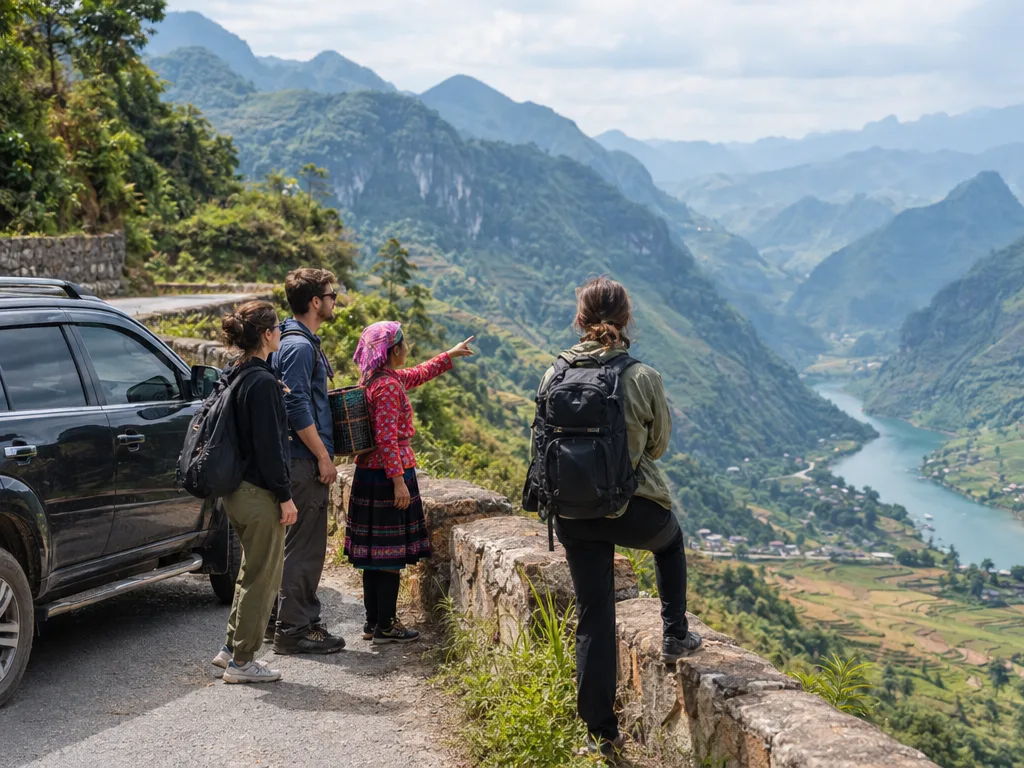
Ha Giang is often described as a motorbike journey, but you do not need to ride yourself to experience the limestone peaks, high passes, village life, and dramatic river valleys of the northern frontier. A local easy rider, private car, or small-group tour can make the region more approachable while leaving you free to watch the landscape and spend time in the places between the famous viewpoints.
This guide explains how to choose the right way to travel the Ha Giang Loop without riding, what each option is good at, how to shape a realistic route, and what to ask before you book. The goal is not to squeeze every attraction into one itinerary. It is to match the vehicle, guide, pace, and overnight stops to your comfort and curiosity.
First, decide what “without riding” means for you
Travelers use “Ha Giang without a motorbike” to describe several different experiences. You might want an easy rider who drives a motorcycle while you sit behind them. You might prefer a private car with more weather protection. Or you may be considering a small group that combines transport, accommodation, and a local guide. These choices feel different on narrow mountain roads, so define your priorities before comparing prices.
- Choose an easy rider if the open-air feeling matters most and you are comfortable as a passenger on a motorcycle.
- Choose a private car if you want more personal space, a calmer ride, or greater protection from cold, rain, and road spray.
- Choose a small group if you value an established route, shared logistics, and the social side of traveling with other people.
- Choose a custom local tour if villages, food, short walks, or photography matter more than completing a standard loop.
None of these is automatically the “best” option. The right answer depends on your luggage, motion sensitivity, mobility, budget, and willingness to spend long periods on winding roads.
Easy rider or car: the practical differences
Easy rider tours
An easy rider arrangement keeps the classic sense of a mountain road journey without asking you to control the bike. You still feel the air, see over low barriers, and stop easily at viewpoints. It can work well for solo travelers and couples who want an active atmosphere but do not have the confidence, permit, or experience to ride unfamiliar mountain roads.
Ask how many hours you will normally spend on the bike each day, what happens if rain arrives, and whether a passenger helmet and protective clothing are provided. Ask to see the luggage plan too. A small day bag is easier to manage than a large suitcase, and your main luggage may need to travel separately or stay in Ha Giang City.
Passenger comfort also depends on the individual driver. Before confirming, ask whether you can meet the driver, whether the driver speaks enough English for day-to-day communication, and how often the itinerary pauses. A good easy rider experience should include time to get off the bike, stretch, drink water, and look at the scenery rather than treating every stop as a quick photograph.
Private or small-group car tours
A car is a sensible choice for families, older travelers, people who dislike motorcycle travel, and anyone visiting during unsettled weather. It also gives you a stable base for layers, snacks, and camera equipment. The trade-off is that mountain roads can feel slower from inside a vehicle, and a larger car cannot always pull over exactly where a motorcycle can.
Clarify the vehicle size, passenger capacity, air-conditioning, luggage space, and whether the same driver stays with you throughout. If you are traveling with children or grandparents, ask how the operator handles frequent breaks and whether the route can be shortened without losing the main experience. A private car is most valuable when it gives your group flexibility, not when it simply reproduces a rushed group itinerary behind closed doors.
Build the route around experiences, not only road mileage
The official Vietnam Tourism guide presents a four-day loop with sections through Quan Ba, Yen Minh, Dong Van, Meo Vac, Bao Lam, and back toward Ha Giang City. That outline is useful for understanding the geography, but a passenger itinerary does not need to copy every turn. Long driving days can become tiring even when you are not the driver.
Instead, choose two or three experiences that you genuinely want. A scenic route might focus on Heaven’s Gate and the karst landscapes around Quan Ba, the high passes toward Dong Van, and the dramatic road near Ma Pi Leng. A culture-led trip might give more time to a homestay, the H’Mong King Palace at Sa Phin, a market, and a textile workshop. A gentler plan might use fewer overnight changes and add short walks from one base.
- For landscape: prioritize viewpoints, pass roads, and unhurried stops rather than collecting every named attraction.
- For culture: ask your guide to explain local etiquette and help you visit communities respectfully.
- For walking: confirm the length, terrain, and elevation of each walk before it is added to the day.
- For photography: allow time for changing light and weather instead of promising a fixed number of viewpoints.
Vietnam Tourism notes that the distance between Dong Van and Meo Vac is relatively short on a map but can take much of a morning when travelers stop for views. That is a useful planning principle: judge a day by the number of meaningful stops and the road conditions, not by kilometers alone.
What a comfortable no-riding itinerary can look like
Day 1: Reach Ha Giang and settle into the region
The journey from Hanoi is commonly described as roughly six to seven hours by car or sleeper bus, so arriving late and immediately beginning a demanding mountain route may not suit everyone. If your schedule allows, use the first evening to meet your guide, check clothing and luggage, and confirm the next day’s departure time. A short stay near Ha Giang City or a nearby village can make the following morning less stressful.
Day 2: Quan Ba and the approach to the plateau
Start with the road north toward Quan Ba and the pass landscape that introduces the Dong Van Karst Plateau. This is a good day for a passenger to learn the rhythm of the trip: how often the driver stops, how much walking is involved, and how the weather changes with elevation. If you prefer a cultural beginning, ask about a village homestay or a locally led meal rather than filling the day with viewpoints.
Day 3: Dong Van, Sa Phin, and a market option
Dong Van works well as a base for combining scenery and history. From here, you may be able to visit the H’Mong King Palace in Sa Phin or arrange a market visit, depending on the calendar and your route. Market schedules can be difficult to pin down, so treat a market as a flexible possibility until your host or guide confirms the timing. Avoid turning a community market into a performance: ask before photographing people and buy thoughtfully.
Day 4: Ma Pi Leng and Meo Vac at a slower pace
The road between Dong Van and Meo Vac is one of the visual highlights of the region. A car or easy rider allows you to focus on the river valley, cliffs, and changing road views, but the journey still needs patience. Build in stops where you can safely leave the vehicle, walk a little, and take in the scale of the landscape. If you add a side walk or river viewpoint, confirm the return route and the time required before setting off.
Day 5: Return with room for change
Weather, road works, fatigue, and local opportunities can all affect a mountain itinerary. A return day with some margin is more enjoyable than a tightly timed chain of transfers. If you have only three or four days, reduce the number of stops rather than trying to compress the full loop. Your guide should be able to explain which section is being removed and what experience you will gain by keeping the remaining route slower.
Questions to ask before you book
Good questions reveal more than a polished itinerary page. Ask for the daily route, approximate departure and arrival windows, and the type of roads involved. Ask whether the tour is private or shared, how many people travel in each vehicle, and whether the guide is also the driver. Confirm what accommodation is included, whether meals are included, and how dietary needs are handled.
- Who drives, and what experience do they have on the mountain route?
- How are helmets, rain layers, and passenger safety handled on an easy rider tour?
- What is the luggage limit and where does larger luggage stay?
- How many hours of driving are expected on the longest day?
- Can the route be adjusted for weather, mobility, or fatigue?
- Are walks optional, and will the guide explain their terrain and duration?
- What is the plan if a road is blocked or conditions change?
Be cautious of any operator who promises perfect weather, guaranteed market dates, or a fixed number of views without explaining the conditions. Mountain travel is more trustworthy when uncertainty is acknowledged.
Pack for changing conditions and passenger comfort
Vietnam Tourism describes Ha Giang as having a cool mountain climate, with wet and slippery roads possible from May through August. The same official guidance highlights September to November for golden rice terraces and buckwheat flowers, but seasonal scenery should not replace a practical weather check before departure.
Pack light layers, a waterproof outer layer, shoes that can handle uneven ground, sun protection, personal medication, and a small bag you can keep with you. Gloves can make an easy rider trip more comfortable, while a scarf or buff helps with wind and dust. Keep electronics in a dry pouch. Bring some cash for rural stops because official route guidance notes that ATMs become scarce outside Ha Giang.
For a car tour, motion-sickness medication may be worth discussing with a pharmacist before travel. Sit where you feel most comfortable, look toward the road when possible, and tell the driver early if you need a pause. For an easy rider tour, do not wait until you are exhausted to ask for a break.
Travel responsibly in villages and protected landscapes
Ha Giang’s appeal comes from living communities and a fragile mountain environment, not only from its roads. Follow your host’s guidance about entering homes, eating, bathing, and photographing. Buy local products when you can, but avoid treating traditional clothing or ceremonies as props. If you visit a market, leave space for residents to shop and work.
Stay on established paths during walks, carry your rubbish, and do not climb barriers for a better photograph. A local guide can help translate, explain context, and direct spending toward communities. The best no-riding itinerary is not the one with the most stops; it is the one that lets you see more while creating less pressure on the places and people you visit.
How to choose with confidence
Choose an easy rider when you want the open-road feeling and are comfortable as a passenger. Choose a private car when protection, space, or flexible pacing matters more. Choose a small group when you want shared logistics and company. In every case, prioritize a clear route, realistic driving days, a responsible local guide, and room to respond to mountain weather.
Ha Giang does not require you to prove anything by riding yourself. With the right transport choice, you can give your attention to the karst peaks, river valleys, villages, food, and conversations that make the journey memorable.
JOIN THE CONVERSATION
Comments (0)
No comments yet. Be the first to share a thought.