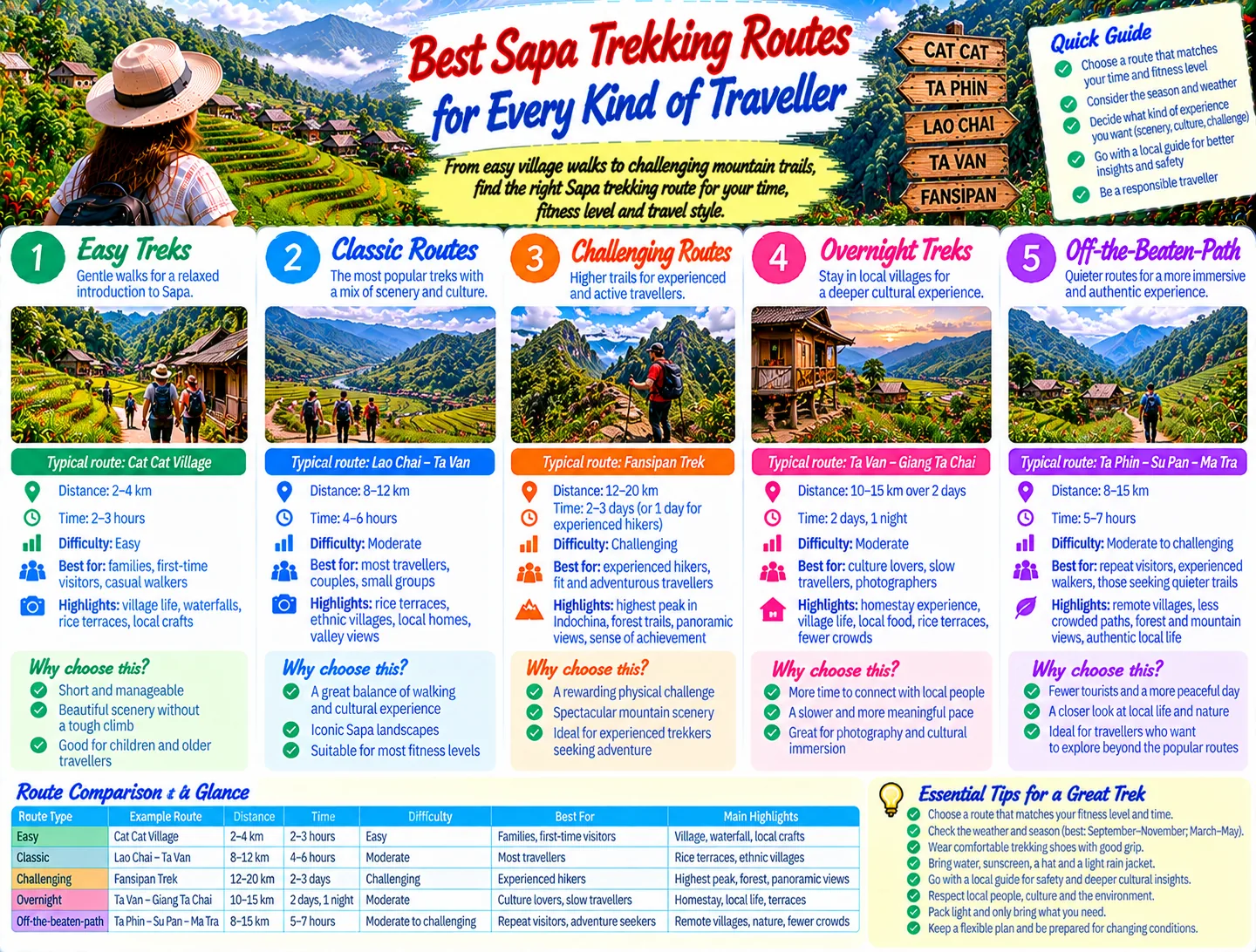
Sapa trekking is easiest to enjoy when the route matches your time, fitness, interests, and comfort with changing mountain conditions. Rather than treating every walk as the same scenic outing, use this guide to choose between a short village loop, a full-day rice-terrace hike, or an overnight trek that puts local life at the centre. Sa Pa’s official tourism profile highlights cool highland weather, dramatic terraces, Fansipan views, and village routes ranging from accessible walks to guided overnight experiences. The aim here is practical: help you choose a rewarding Sapa trekking route without overpacking your itinerary or making promises a trail cannot keep.
Start with the kind of Sapa trek you actually want
The best Sapa trekking route is not automatically the longest or highest. It is the one that gives you enough time to walk comfortably, notice the landscape, and return with energy left for the next day. Before choosing a trail, decide which experience matters most.
Village and culture: choose a route where a local guide can explain homes, farming, weaving, food, and everyday life rather than rushing between viewpoints.
Rice-terrace scenery: prioritise valley paths and allow time for weather, photography, and uneven ground.
Physical challenge: ask about steep climbs, slippery sections, stream crossings, and the expected walking pace before you book.
Quiet immersion: consider a longer or overnight trek, where the day is shaped by villages and mountain paths instead of a checklist of stops.
For a wider framework on matching an activity to your group, see Choosing an Outdoor Adventure That Suits Your Group. It is especially useful if one traveller wants a serious hike while another prefers a slower village walk.
Short Sapa trekking routes for a first walking day
Choose a compact route when time or confidence is limited
A short trek works well after arriving in town, before a long journey, or when your group has mixed fitness levels. Routes towards nearby villages can offer terraces, footpaths, homes, streams, and changing views without requiring a full day in the hills. The official Vietnam Tourism guide notes that villages such as Cat Cat and Ta Phin can be visited on foot, while also recommending guided treks for deeper experiences. Treat that as a planning distinction: a walk may be possible independently, but a guide can add context and help you judge conditions.
Do not measure a short route only by distance. Mountain paths can be uneven, and wet weather can make stone, soil, and steps slower to cross. Wear shoes with dependable grip, carry water, and keep your schedule flexible. If you are travelling in a group, agree on a pace before leaving rather than allowing the fastest walker to set the rhythm for everyone.
What to ask before setting out
How much of the route is on paved road, steps, or narrow soil paths?
Are there steep sections that require a slow ascent or careful descent?
Where can the group pause if weather changes?
Does the route finish near your accommodation or require a separate transfer?
For broader preparation, the site’s Mountain Trekking & Hiking category has related guidance on making a mountain day safer and more enjoyable.
Full-day Sapa trekking routes for terraces and viewpoints
Build the day around terrain, not just landmarks
A full-day Sapa trek is the strongest choice if you want a sense of the valley rather than a quick taste. The route may pass through terraced slopes, bamboo, waterfalls, and village areas, but the quality of the day depends on how those pieces fit together. Ask your guide to describe the walking surface and elevation changes in plain language. “Beautiful views” does not tell you whether the day includes long descents, exposed steps, or muddy paths.
Start early enough to walk without rushing, but do not assume an ambitious itinerary is automatically better. A slower pace creates room to stop at a viewpoint, watch farm work from an appropriate distance, or learn how a local family uses the landscape. The official sustainable travel guide recommends discussing the itinerary with your guide so the balance between mountain walking and village life suits you. That flexibility is valuable when clouds hide the highest views or rain changes the trail.
How to plan for the seasons
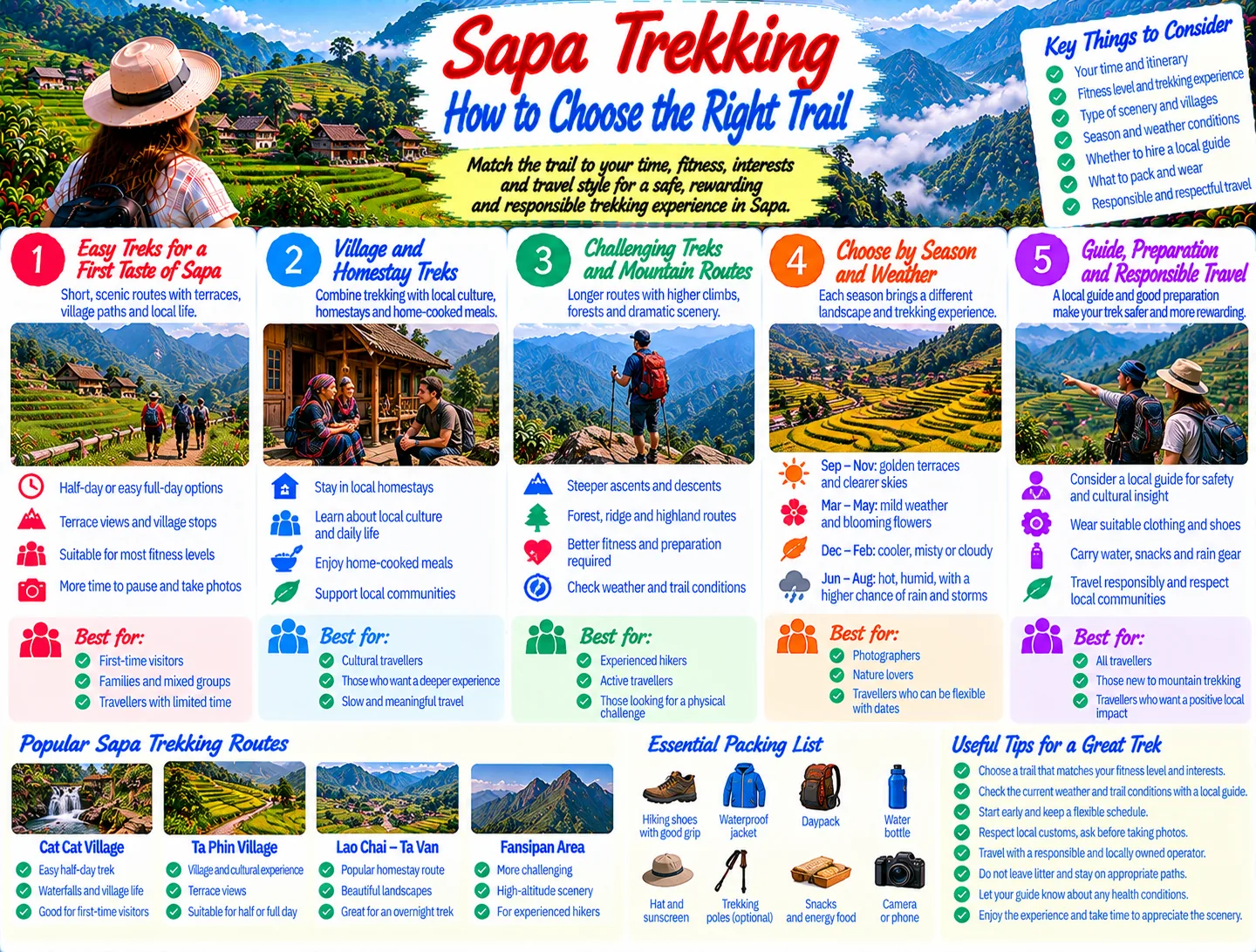
Vietnam Tourism lists September to November as a particularly attractive period for Sa Pa, with golden terraces and clearer skies, and describes March to May as mild with blooming flowers. These are useful planning signals, not guarantees for every day. Weather can still shift quickly in a highland environment, so carry a light waterproof layer and protect electronics. If your priority is a particular terrace colour, ask locally what the landscape is likely to look like during your dates instead of relying on a stock photograph.
For a responsible approach to outdoor travel across the region, read How to Visit Northern Vietnam’s Wild Places with Care. The same habits matter on a Sapa trail: stay on appropriate paths, keep waste with you, and let the landscape remain part of someone’s home and livelihood.
Overnight treks and homestay experiences
Choose an overnight trek for depth, not simply distance
An overnight Sapa trek suits travellers who want the mountains to shape the trip instead of fitting a walk into a sightseeing schedule. The official sustainable travel guide presents overnight trekking as a way to spend time in small ethnic villages and experience a different rhythm of mountain life. The value is not a guaranteed “authentic” performance; it is the chance to travel more slowly, listen, and support a locally rooted stay when the arrangement is respectful and transparent.
Before booking, ask who owns the guiding service, where the overnight stay is located, what is included, and how the group handles meals, rubbish, bathrooms, and cultural boundaries. A small homestay may be simple. Clarify that in advance so comfort expectations do not overshadow the experience. If you have dietary, mobility, or privacy needs, raise them before departure rather than assuming every village stay can accommodate them.
Make the homestay part of the route decision
Some travellers choose a trail first and add any available homestay later. A better approach is to decide whether you want a family-style stay, a quieter lodge, or a shorter walk with a return to town. Vietnam Tourism notes that homestays can supplement farming income and create opportunities to hear local stories and share food. That benefit depends on choosing thoughtfully and behaving as a guest: ask before photographing people or homes, follow household customs, and buy only what you genuinely want.
For another low-impact northern Vietnam perspective, browse the Pu Luong Nature Escapes category. The landscapes differ, but the planning lesson is similar: nature-based travel is stronger when the pace leaves room for residents and the environment.
Guided or independent: choosing the right support
Independent walking can suit confident hikers on clear, straightforward routes, but a local guide becomes more valuable as the trail gets longer, the weather worsens, or the group wants cultural context. A guide can help translate conversations, explain local practices, adapt the pace, and make a route decision when conditions change. The official Sapa destination page specifically distinguishes villages that can be visited without a guide from the richer possibilities of guided or overnight trekking.
When comparing operators, look beyond dramatic photographs. Ask whether the guide is local, how many people will be in the group, whether the itinerary is adjustable, and what happens if a traveller cannot continue. A responsible operator should answer clearly rather than treating safety or community relationships as an afterthought. You should also be able to state your experience honestly. Saying that you are comfortable walking on hills is different from saying you regularly hike steep, wet trails.
What to pack for a comfortable mountain walk
Pack for changeable conditions and uneven ground, not for a city stroll. A practical day kit usually includes grippy walking shoes, breathable layers, a waterproof outer layer, sun protection, drinking water, a small snack, personal medication, and a phone or camera protected from rain. Keep the load light enough that you can descend safely. Trekking poles can help some walkers, particularly on slippery descents, but they are not a substitute for sensible pacing.
Footwear: choose grip and stability over fashion; test new shoes before the trek.
Clothing: use layers so you can adjust between sun, wind, mist, and cooler shaded paths.
Rain protection: keep a jacket and a simple dry bag accessible, not buried at the bottom of a pack.
Respectful essentials: carry reusable water storage and avoid bringing disposable items you will struggle to pack out.
Money and documents: keep only what you need for the day secure and dry.
Check whether lunch, transfers, and water are included in your chosen trek, because arrangements differ. Do not assume a route with a village stop has a shop or a reliable place to buy supplies.
Plan a better Sapa trekking itinerary
A thoughtful itinerary gives the trek enough space to be enjoyable. If you have one full day, reserve it for a route that matches your fitness rather than trying to combine a demanding hike with every major attraction. If you have two or more days, use the first walk to understand the terrain and save an overnight trek for when you know how your body is responding to the altitude, climbs, and descents.
Sa Pa also connects naturally with a wider northern Vietnam trip. The site’s A Practical First-Timer’s Guide to Northern Vietnam Adventures can help you place trekking alongside other outdoor experiences without turning the whole journey into a race. If you are arriving by road, leave realistic transfer time; the official tourism guide describes travel via Lao Cai followed by a road transfer to Sa Pa, while its sustainable guide outlines road and night-train options from Hanoi. Treat quoted journey durations and fares as time-sensitive and verify them before departure.
Final checklist before you book
Choose a route length that leaves room for weather and rest.
Ask for a plain description of climbs, descents, surfaces, and transfers.
Decide whether cultural explanation, photography, scenery, or challenge is your main priority.
Confirm what the price includes without assuming current fares or meal arrangements.
Choose local, responsible guiding where possible and ask how the operator supports communities.
Pack grip, layers, rain protection, water storage, and personal essentials.
Ask permission before photographing people, homes, or ceremonies.
Conclusion
The best Sapa trekking route is the one that fits your real travel style: a short village walk for a gentle introduction, a full-day valley hike for terraces and changing scenery, or an overnight trek for a slower connection with mountain communities. Start with the experience you want, ask precise questions about terrain and logistics, and leave enough flexibility for weather. With that approach, Sapa trekking becomes more than a list of viewpoints—it becomes a considered way to move through the landscape.
JOIN THE CONVERSATION
Comments (0)
No comments yet. Be the first to share a thought.