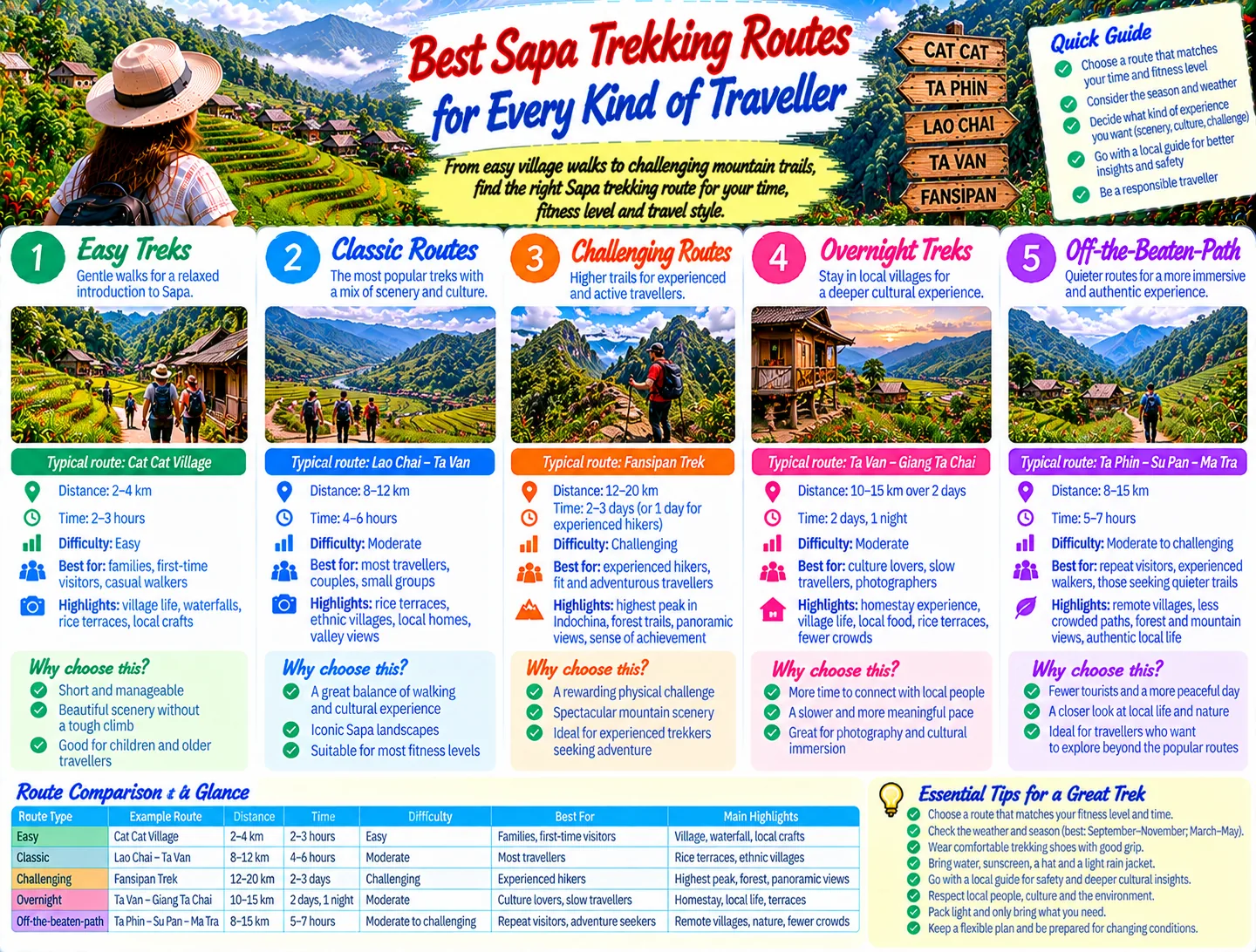
Sapa trekking is not one single experience. In the hills above town, a short village walk, a full-day rice-terrace route and a demanding high-mountain outing can all look like “a trek” in a search result, yet they require different fitness, timing and expectations. The best choice is the one that matches your day, the weather and the kind of contact you want with the landscape.
Sa Pa sits above a deep valley of working rice terraces, with villages, rivers and mountain paths spreading away from the town. Vietnam’s national tourism authority describes the area as a major trekking destination and notes that some nearby villages can be visited without a guide, while overnight walks create more time for terraces, waterfalls and local culture. Use this guide to choose a route thoughtfully rather than chasing the longest distance.
Start with the trek you actually want
Before comparing named routes, decide what you want the day to feel like. A first-time visitor may be looking for scenery and a manageable introduction, while an experienced hiker may want sustained climbing, quieter paths or a night in the hills. Those are different products, even when they begin in Sapa town.
Choose by time and effort
- A short walk: best when you have limited time, uncertain weather or a mixed-ability group. Prioritise viewpoints, village lanes and a relaxed pace.
- A full-day trek: the most balanced option for seeing changing terrain without committing to an overnight plan. Ask how much of the day is walking rather than driving between trailheads.
- An overnight trek: worthwhile when you want the landscape after day visitors have left and you are comfortable with simple accommodation, changing conditions and an earlier start.
Do not judge difficulty by distance alone. Wet steps, slippery earth, repeated descents and altitude changes can make a short route tiring. Ask the organiser for ascent, descent, surface, walking time and the least flexible part of the route.
Understand Sapa’s main trekking landscapes
Sapa’s appeal comes from variety. The view changes from town streets to cultivated slopes, narrow paths, streams, forest edges and homes set among the terraces. A useful itinerary gives you more than one landscape without turning the day into a race.
Terraces and valley paths
Rice terraces are working agricultural land, not a theme-park backdrop. Paths may pass beside fields, through hamlets or along narrow contours. In the growing season, the slopes can be vivid green; nearer harvest, they may turn gold. Conditions and colours vary, so treat seasonal descriptions as a guide rather than a guarantee.
Stay on the route your guide or host identifies. A shortcut across a planted field can damage crops, disturb household routines or create erosion. The most considerate trek is often slightly slower because it respects the landscape that makes the view possible.
Villages, streams and forested sections
Village walking is about observation as much as scenery. Homes, footbridges, livestock and farm work share the same space as the trail. Keep voices low near houses, ask before photographing people and do not assume that a marketable craft or household activity is a public performance.
Stream crossings and shaded paths can feel cooler than town. They may also stay damp after rain. Shoes with secure grip matter more than fashionable hiking gear, and trekking poles can help on descents if you are unused to uneven ground.
How to choose a guide and local operator
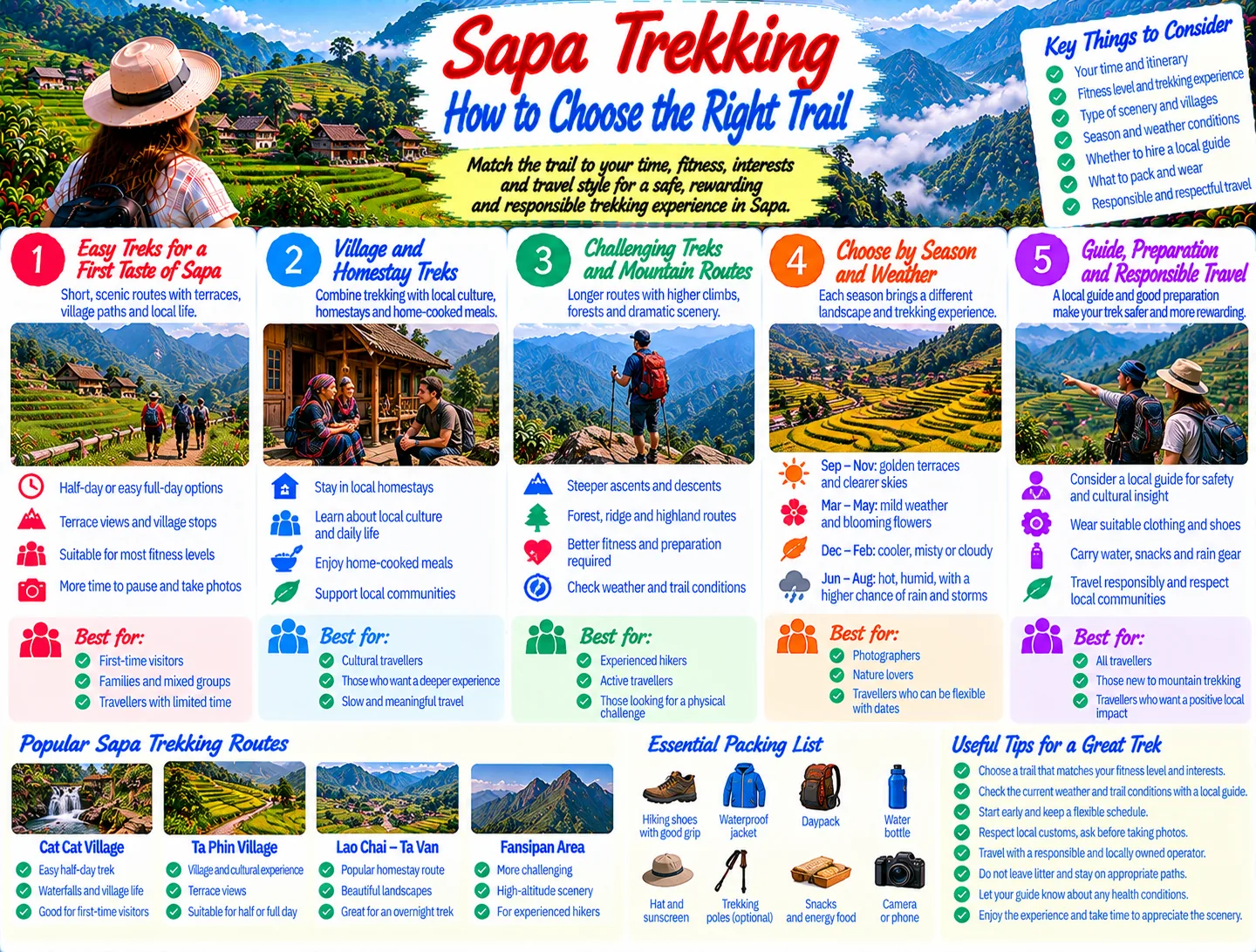
A local guide can add far more than directions. The right person helps interpret the landscape, adjust the pace, explain etiquette and make a safer decision when rain changes the trail. A guide is especially useful for a full-day or overnight trek, for solo travellers and for anyone who is unsure how much climbing they can handle.
Questions worth asking before booking
- What is the actual walking time, excluding transfers and meal stops?
- How much uphill and downhill walking is involved?
- What happens if heavy rain makes a section unsafe?
- How large is the group, and can the pace be adjusted?
- Which village, homestay or community partners receive the booking?
- What should you bring, and what is supplied?
Be cautious with promises of “secret” routes or guaranteed weather. A responsible operator should be able to explain uncertainty clearly. Read the itinerary as a plan, not a contract with the mountain: paths, visibility and local access can change.
For broader preparation, the site’s safer mountain trail guide is a useful companion. If your trip includes several outdoor activities, compare your options in Outdoor Adventure Activities before committing to the hardest day.
Plan around weather, season and daylight
Sa Pa has a cool highland climate, with misty mornings, cold winters and occasional frost around Fansipan, according to Vietnam Tourism. The same page highlights September to November for autumn colour and clear skies, while March to May can bring mild conditions and flowers. These are useful planning windows, not promises of dry trails every day.
Build a flexible day
Leave room to start later if visibility is poor or to finish before conditions deteriorate. Mist can make a dramatic view disappear while leaving the trail perfectly walkable; heavy rain can do the opposite by turning a manageable path into a slippery one. Ask locally about the morning’s ground conditions instead of relying only on a long-range forecast.
Pack a light waterproof layer, a warm layer, water, a small snack, sun protection and a dry bag for electronics. Wear shoes that can get muddy. If you are staying overnight, confirm whether bedding, towels and hot water are available rather than assuming that every homestay offers the same facilities.
Fansipan is a separate planning decision from a valley trek. The official Sun World Fansipan site currently lists operating hours and warns that they can change, so check the operator directly before building a cable-car visit into a fixed itinerary. Treat the summit experience as a mountain-weather outing even when the ascent is assisted; wind, cloud and cold can still affect comfort.
Walk respectfully through living communities
Sapa’s trails cross places where people live and work. Responsible travel is not an extra paragraph at the end of an itinerary; it changes how you move through the day.
Simple etiquette that helps
- Ask before taking close-up photographs, especially of children, homes or ceremonies.
- Do not enter a house, yard, field or shrine without an invitation.
- Buy directly from makers when you genuinely want an item, and avoid aggressive bargaining over small purchases.
- Carry your rubbish out and minimise single-use packaging.
- Keep dogs, livestock and working animals at a respectful distance.
- Use a toilet when one is provided rather than treating the trail or stream as a convenience.
A good guide can explain when a path is private, when a ceremony is not for visitors and how to ask questions without turning a household into a photo stop. If a group’s behaviour feels intrusive, say so early; the guide can usually reset the tone before the problem grows.
The site’s guide to visiting wild places with care offers principles that also apply to Sapa’s cultivated valleys. For a wider trip built around walking, browse Mountain Trekking & Hiking for related planning ideas.
Make meals and overnight stays part of the route
Food and accommodation can shape the quality of an overnight trek as much as the walking itself. Ask what is included, where meals are served and whether dietary needs can be handled before you leave town. Be specific about allergies rather than assuming that a dish is safe because it looks simple.
At a homestay, follow the household’s lead. Keep shared spaces tidy, use water thoughtfully and ask before rearranging anything. A simple stay may be the point: the value is time in the valley, not hotel-style service. If you need private facilities, reliable heating or other essentials, state that clearly during booking so the itinerary can be matched to you.
Consider your return as well as your arrival. An overnight route should end somewhere with a clear onward plan, and a full-day trek should leave enough margin for transport, a shower and dinner without forcing your guide to rush the final section.
Use Sapa’s wider adventure menu wisely
Not every mountain day needs to be a trek. Vietnam Tourism also highlights mountain biking and the Vietnam Mountain Marathon as ways to experience the area, while the official Fansipan operator provides a separate summit attraction. Combining activities can work, but avoid stacking demanding plans simply because they look efficient on a map.
If Sapa is one stop in a longer northern itinerary, the site’s first-timer’s guide to Northern Vietnam adventures can help you balance travel days with active days. You can also compare nearby walking-focused destinations through Pu Luong Nature Escapes, especially if you prefer a slower landscape experience after Sapa.
Keep the principle simple: choose one experience that deserves your full attention, then add a lighter activity only if your body, weather and schedule genuinely allow it.
Know when to shorten or turn back
A flexible trek is a stronger trek. If rain is making steps unstable, visibility is collapsing on an exposed section or someone in the group is struggling to keep balance, ask for a shorter alternative. Turning back is not a failure; it is a normal mountain decision. A good guide should be willing to change the plan without making the group feel that it has lost face.
Notice small warning signs early: persistent slipping, unusual fatigue, a headache that worsens, wet clothing that cannot dry or a pace that leaves one person far behind. Pause, drink water and tell the guide what is happening. Keep your phone protected, but do not let navigation distract you from the people and ground around you. If you have a medical condition or previous injury, share the relevant limitation before departure so the route can be adjusted from the start.
For many travellers, the most memorable part of a Sapa hike is not reaching a dramatic viewpoint. It is moving slowly enough to see irrigation channels, hear a stream below the path and understand how the terraces fit together. Build the day around that attention.
A practical Sapa trekking checklist
- Choose a route by walking time, ascent, descent and surface, not its name alone.
- Check the weather and local trail conditions on the morning of departure.
- Wear secure, broken-in footwear and bring rain and warmth layers.
- Confirm guide services, meals, accommodation and cancellation arrangements in advance.
- Ask permission before photographing people, homes or cultural activities.
- Stay on agreed paths and keep rubbish out of fields, streams and villages.
- Leave a time buffer for slow walkers, wet ground, mist and route changes.
- Recheck official operating information before a Fansipan cable-car visit.
Conclusion: choose the right pace
The best Sapa trekking itinerary is not necessarily the longest or most dramatic. It is the one that lets you notice the terraces, walk safely on the actual ground, meet local communities respectfully and finish with enough energy to appreciate the day. Choose a route that fits your time and ability, use a guide when it adds real value, and leave space for the mountain to set the pace.
JOIN THE CONVERSATION
Comments (0)
No comments yet. Be the first to share a thought.