Sapa trekking is best understood as a way of moving through a living mountain landscape, not as a checklist of viewpoints. Rice terraces fold down the hillsides, paths pass through villages and streams, and weather can change the character of a route within minutes. The right trek depends on your time, fitness, footwear, appetite for steep ground and interest in travelling with a local guide. This guide helps you choose a route, plan each day and walk respectfully without promising conditions that the mountains cannot guarantee.
What makes Sapa trekking different?
Sa Pa sits at the head of a deep valley in northern Vietnam, surrounded by high ridges, cultivated terraces and small communities. The national tourism authority describes the area as a cool highland destination with misty mornings, mountain scenery and access via Lao Cai followed by a road transfer. Its official destination guide also highlights the valley’s terraces, Fansipan and hill walking as central parts of the experience: see the official Sa Pa destination overview before fixing your plans.
That setting creates two different kinds of trekking day. A short walk from town can give you terraces, village lanes and broad views without requiring an overnight stay. A longer trek trades convenience for quieter paths, more elevation and a closer look at farming landscapes. Neither is automatically better. A route that matches your pace will usually be more rewarding than an ambitious itinerary that leaves you exhausted before the best section.
Choose the experience before the route
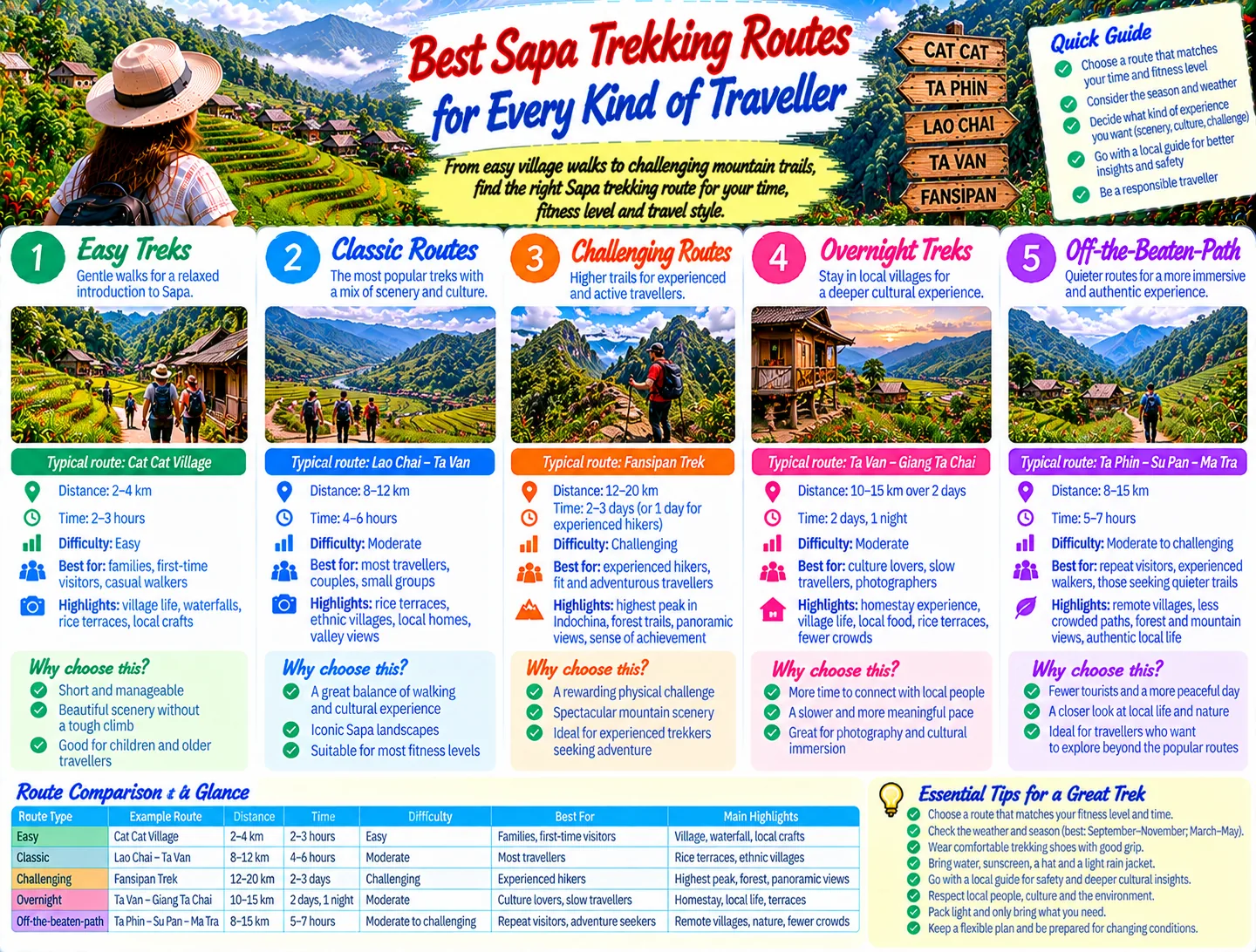
- Choose a half-day walk if you have limited time, uncertain weather or a group with mixed fitness.
- Choose a full-day valley trek if terraces, villages and changing scenery matter more than ticking off a summit.
- Choose an overnight homestay trek if you want slower travel, evening conversation and an early start away from town.
- Choose a demanding ridge or summit day only when everyone understands the distance, uneven ground and weather exposure.
How to choose a Sapa trekking route
Route names are useful shorthand, but they do not tell you how a day will feel. Ask for the approximate walking time, the steepest section, the surface underfoot, the likely transport at the start or finish and whether the route can be shortened. A good guide should be able to explain the plan in practical terms rather than relying on a dramatic name.
Valley walks and terrace routes
Valley routes are usually the most approachable introduction to Sapa hiking. They combine narrow paths, cultivated slopes, streams and settlements, with frequent opportunities to pause. In wet weather, mud and slick stone can make an apparently easy descent more demanding than the uphill section. Allow time for photographs without treating every viewpoint as a safe place to stand; terrace edges and wet banks are not platforms.
Village-to-village treks
Village routes suit travellers who want a clearer sense of place. The point is not simply to arrive at a named settlement, but to notice how paths connect homes, fields, small bridges and working areas. Keep the group compact, follow the guide’s advice around private homes and avoid turning ordinary daily life into a staged performance. If you are interested in broader walking choices, compare this guide with Sapa on Foot: Choosing a Trek That Fits Your Day.
Fansipan and high-elevation days
Fansipan is a different proposition from a valley trek. The mountain dominates the skyline and can be reached through a combination of transport and walking experiences, but a high point does not guarantee clear views. Cloud, wind, cold and fatigue may all be part of the day. Treat summit plans as weather-dependent, carry an extra layer and avoid assuming that a cable-car visit and a long trail day require the same preparation.
When is the best time to trek in Sapa?
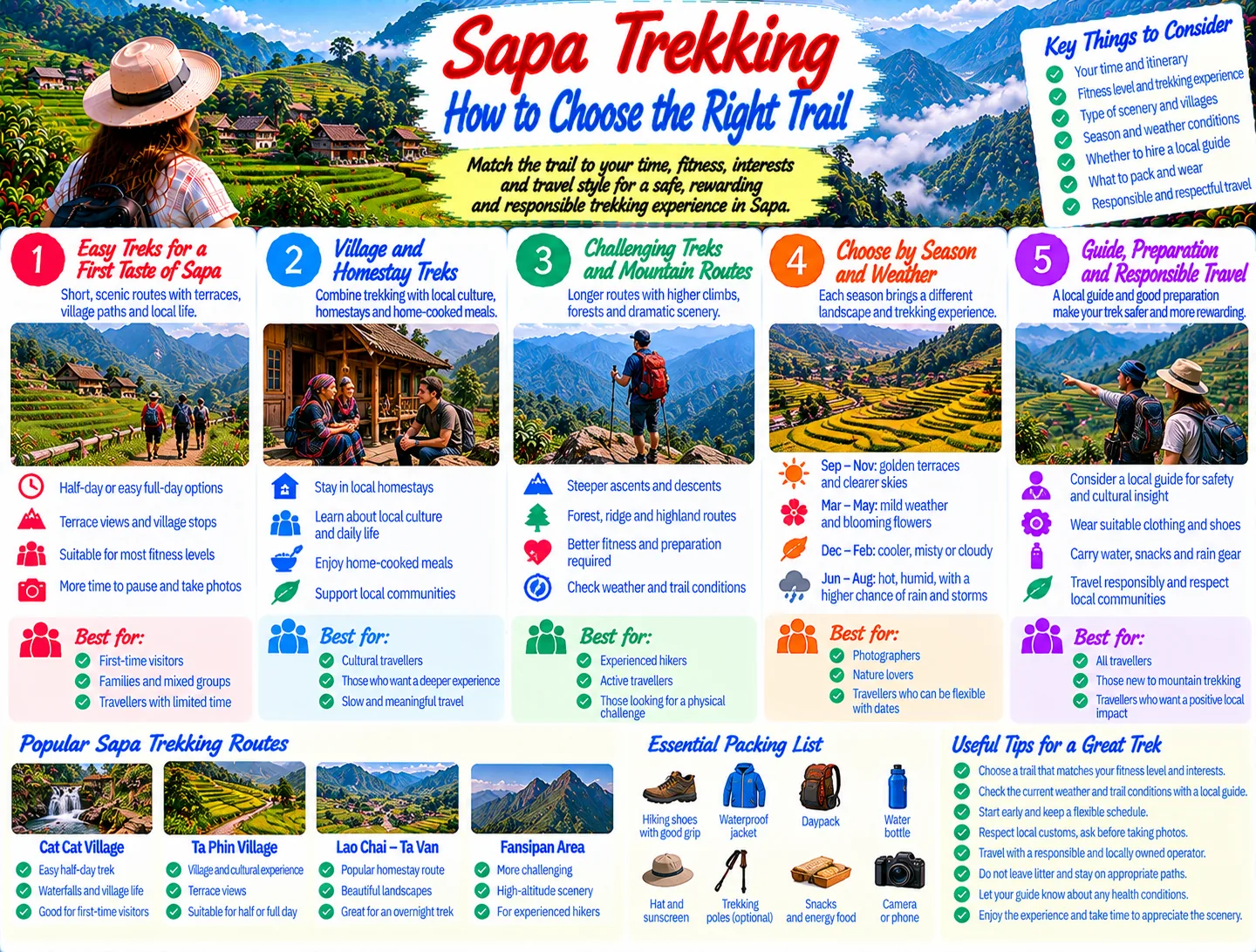
There is no single best month for every traveller. The official Sa Pa guide points to September to November for autumn conditions and golden terraces, while March to May is described as mild with blooming flowers. Those seasonal patterns are helpful, but they are not a promise of dry paths or clear skies on a specific date. Summer can bring vivid green landscapes and heavier rain; winter can mean cold, mist and limited visibility, especially higher up.
Plan around the experience you value most:
- For terrace colour, look at the farming calendar and accept that exact harvest timing varies.
- For comfortable walking, spring and autumn are often attractive, but pack for quick changes.
- For quieter paths, consider less popular days and start early rather than chasing a perfect forecast.
- For photography, build in flexibility. Mist can hide distant ridges while making nearby terraces atmospheric.
Check the local forecast shortly before departure and ask your accommodation or guide about trail conditions. If rain has affected bridges, steps or slopes, a shorter route is not a failure; it is sensible route management.
What to pack for Sapa hiking
Pack for changing surfaces rather than for a fashionable mountain look. Comfortable shoes with dependable grip are more valuable than brand-new boots that have not been worn in. If your route includes wet ground, sandals or smooth-soled trainers are poor substitutes for footwear that can handle mud and uneven stone.
- Light layers, including a warm top for early starts and higher ground.
- A waterproof jacket or poncho, even when the morning begins clear.
- Small daypack, refillable water bottle, snacks and a simple first-aid kit.
- Sun protection, insect protection and a dry bag or waterproof cover for electronics.
- Walking poles if you are comfortable using them on descents.
- Cash for small purchases where electronic payment may not be practical, without assuming every stop accepts it.
Keep the pack light. A heavy bag magnifies every steep step and makes balance harder on slippery paths. For an overnight trek, ask in advance what the homestay provides and whether a larger bag can be left in town. Do not pack based on an unverified list of current facilities; conditions vary between stays.
Guides, homestays and responsible local travel
A local guide can improve more than navigation. They can explain the landscape, adjust the pace, identify safer alternatives and help a visitor understand when a path passes through someone’s working or private space. Before setting out, agree on the route, expected walking time, meeting point, what happens if weather changes and whether meals or transport are included. Avoid choosing solely on the lowest headline price when the details are unclear.
Homestays can make an overnight trek feel personal, but they are still homes and working businesses. Ask before photographing people, bedrooms, animals or family activities. Follow house rules, keep noise down and be open to simple meals rather than expecting a hotel menu. A small purchase from a local shop or a fair payment for guiding is more meaningful when it reflects real work and does not turn every interaction into a negotiation.
For wider principles on visiting fragile landscapes, read How to Visit Northern Vietnam’s Wild Places with Care. The same habits apply on Sapa trails: carry rubbish out, stay on established paths where practical, do not pick crops or plants, and keep streams and village spaces clean.
How to plan a safe trekking day
Start with a route that leaves margin. A schedule that works only if every viewpoint, bridge and transfer happens perfectly is too tight for mountain travel. Tell your guide about injuries, medication, allergies and the slowest walker in the group. If you are travelling independently, share your plan with your accommodation and avoid setting off on an unfamiliar long route late in the day.
Manage descents as carefully as climbs
Many visitors prepare mentally for uphill effort and underestimate the knees, ankles and concentration required on the way down. Shorten your stride, use available support without grabbing fragile vegetation and leave space between walkers on steep or muddy sections. When the surface becomes unsafe, stop and reassess rather than allowing the group to spread out.
Know when to turn back
Turn around if thunder, rising water, poor visibility, injury or severe fatigue changes the risk. A route is not a contract. Guides may suggest a different village, road transfer or return path; listen to local knowledge even when it changes the itinerary you imagined. For general preparation across the region, the site’s Safer, More Enjoyable Day on a Mountain Trail offers useful planning principles.
A practical Sapa trekking itinerary
One day
Use the morning for a valley or village route selected around your fitness and the forecast. Leave time for pauses, lunch and the return journey rather than adding a second distant viewpoint by default. If cloud closes in, focus on the nearer landscape: terraces, paths, homes and vegetation can be more memorable than a distant panorama.
Two days
Make day one a moderate walk with enough time to settle into the terrain. Sleep near the end of the route, then begin day two early if conditions are comfortable. Confirm how you return to Sapa before leaving town, especially if the walk finishes away from your original starting point. A simple, flexible two-day plan is usually better than trying to combine a long valley trek with a demanding summit visit.
Three or more days
Use the extra time to vary the rhythm: one longer walking day, one shorter exploration day and one weather buffer. You can also compare Sapa with the site’s broader Mountain Trekking & Hiking guidance or Outdoor Adventure Activities category before committing your whole trip to one type of outing.
Common mistakes to avoid
- Booking a route from a photo without asking about terrain, distance and elevation.
- Wearing smooth shoes because the forecast looks dry in town.
- Assuming a clear morning means a clear ridge later in the day.
- Rushing through villages and treating residents as scenery.
- Carrying too much, then walking too slowly to finish safely.
- Leaving no time for a weather-related change of plan.
Good Sapa trekking is less about proving endurance than making sound decisions repeatedly: choose a suitable route, respect the people and land around it, watch the weather and keep enough energy to enjoy the return. With that approach, even a short walk can reveal why this highland valley remains one of northern Vietnam’s most compelling places to travel on foot.
JOIN THE CONVERSATION
Comments (0)
No comments yet. Be the first to share a thought.