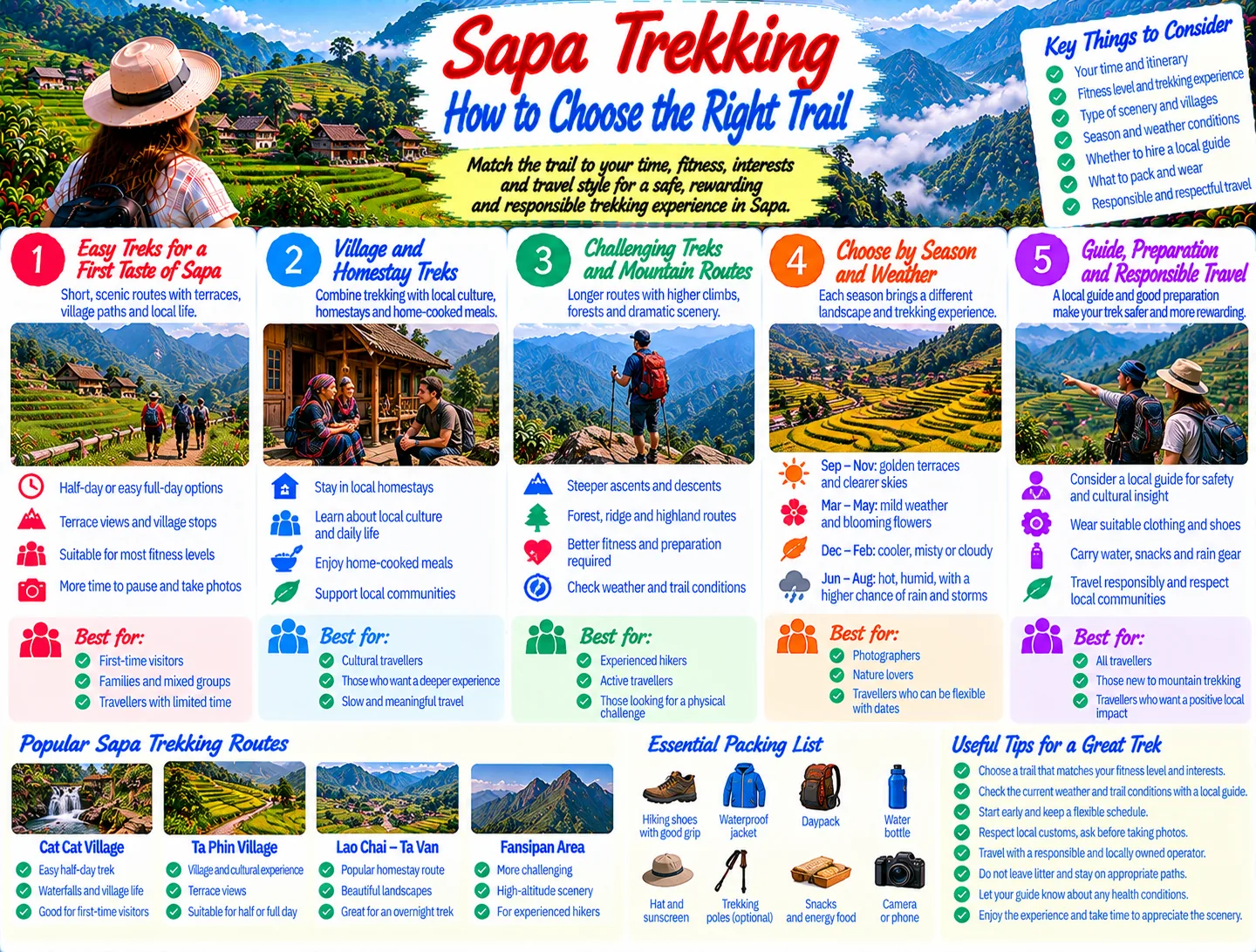
Planning a Sapa trekking trip is less about finding the hardest trail and more about matching the walk to your time, fitness, weather tolerance, and interest in village life. The best route may be a half-day path through rice terraces, an overnight homestay trek, or a quieter walk with a local guide. Sa Pa sits above a deep valley of working terraces, mountain streams, and high ridges, so even a short outing can feel substantial. This guide explains how to choose, prepare for, and enjoy a responsible Sapa trek without treating every trail as the same experience.
Start by choosing the kind of Sapa trek you actually want
Search results often make trekking in Sapa sound like one standard activity. In practice, routes differ in length, surface, scenery, village contact, and the amount of climbing. Decide what you want the day to feel like before choosing a place name.
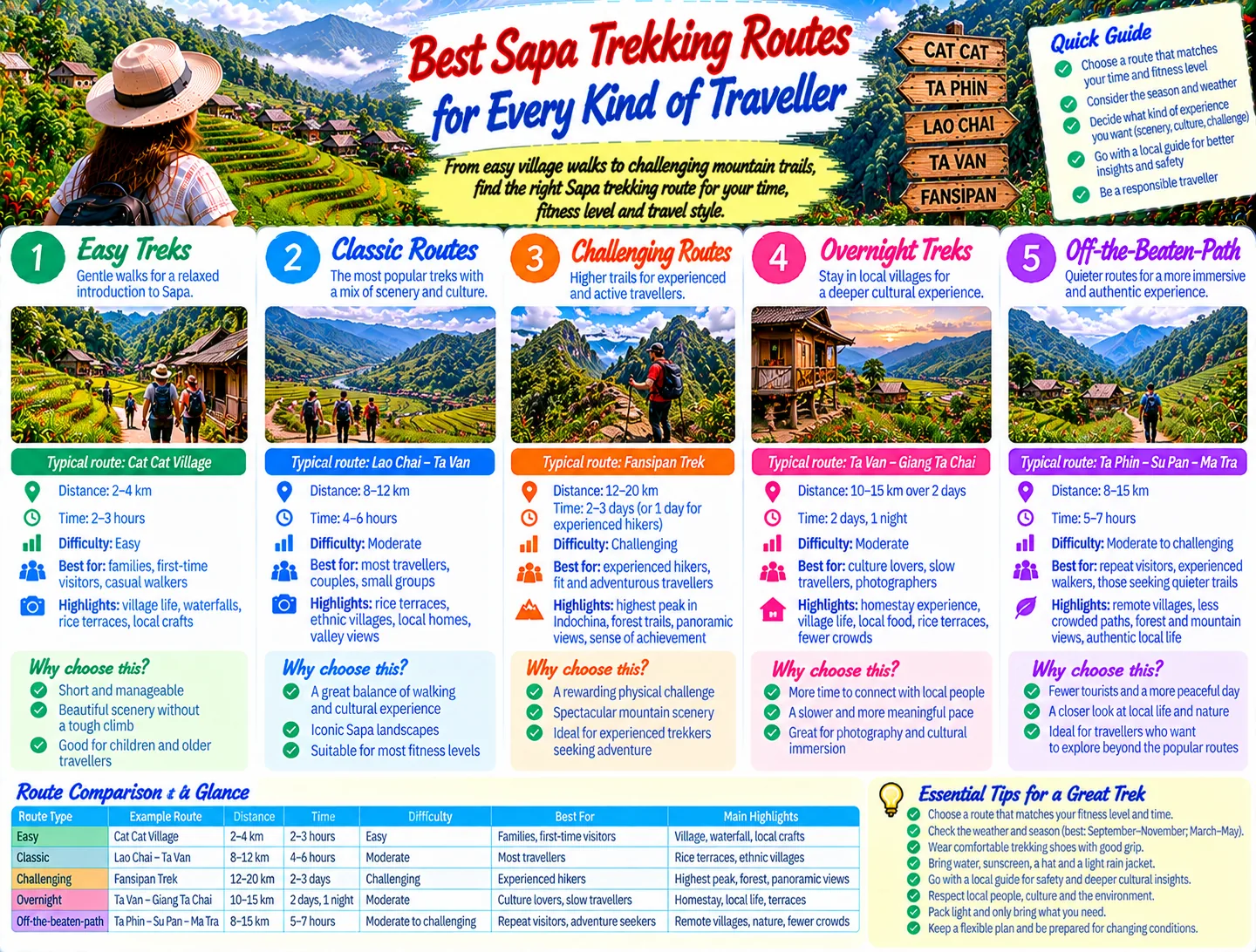
For a first taste of the valley
A half-day or easy full-day walk is useful if you are visiting Sapa briefly, travelling with mixed abilities, or arriving after a long journey. Choose a route where the main reward is landscape rather than distance: terrace views, footpaths between farms, a stream crossing, or a village stop. You will have more time to pause, take photographs, and adjust your pace instead of spending the day trying to complete a route that is too ambitious.
For a deeper village experience
An overnight trek changes the rhythm. Walking is only part of the experience; the evening, shared meal, and conversation at a homestay matter just as much. Vietnam’s official tourism guidance describes Sapa as a place where homestays can connect visitors with local life while supporting household income, and it recommends discussing the itinerary with a guide before setting out. That makes an overnight trek a good choice for travellers who want context, not simply a scenic walk.
For a more demanding mountain day
Longer routes with steep, uneven, or muddy sections require better preparation. You may be walking for several hours with repeated climbs and descents, not merely covering a long distance on a flat path. If your priority is a summit or a challenging ridge, say so clearly when booking and ask what the hardest section involves. Do not select a route only because its advertised distance looks manageable.
Use the season to shape your expectations
Sa Pa has a cool highland climate, with misty mornings, cold winters, and occasional frost around Fansipan. The official destination profile highlights September to November for golden terraces and clearer skies, while March to May is milder and associated with blooming flowers. These are useful planning signals, not promises of perfect trail conditions.
In wetter periods, a route can take longer because clay and stone become slippery. Low cloud may soften the views that attracted you to the area, while rain can make exposed paths tiring. In drier, clearer weather, you may walk more quickly but also feel the effect of sun and altitude sooner. Build flexibility into your plan: a route that is enjoyable in dry weather may need to be shortened after heavy rain.
Ask your guide about the current condition of the specific path rather than relying on a generic “best time” label. A local guide can also suggest a lower, more sheltered route if cloud or rain has closed in on the higher slopes. Keep one unplanned morning available if the scenery is important to you.
Pick a route by terrain, not just by village name
Village names are useful for orientation, but they do not tell you everything about a trek. Before you confirm, ask four practical questions: How many hours will we walk? How much ascent and descent is involved? What is the most difficult surface? Where can we stop if someone is tired?
Terrace and valley paths: rewarding for scenery and farming landscapes, but often uneven, with narrow sections and steps.
Forest and stream routes: cooler and atmospheric, yet more affected by wet weather, roots, stones, and crossings.
Village-to-village walks: good for an overnight plan, but the distance and elevation can vary considerably between itineraries.
High-ridge or summit routes: more exposed to cloud, wind, and steep gradients; these need honest fitness assessment.
Use this framework alongside the site’s guide to choosing a Sapa trek for your day. It is especially helpful when two routes sound similar online but offer very different effort levels on the ground.
Decide whether you need a local guide
Some well-known walks near Sa Pa can be attempted without a guide, and the official Vietnam Tourism destination page notes that villages such as Cat Cat and Ta Phin may be visited independently. That does not mean every route is equally clear, easy, or culturally straightforward. Once you move beyond the most familiar paths, navigation, changing weather, and local etiquette become more important.
A local guide can help you choose a route that matches your ability on the day, explain farming landscapes and village life, and adjust the plan when conditions change. The official sustainable-travel guidance recommends choosing locally owned operators and talking through the itinerary before departure. Ask who will lead the walk, how the route supports local communities, and whether the plan includes a village visit, meal, or homestay.
Guiding is also a practical safety layer. Tell the guide about knee problems, asthma, low confidence on steep ground, dietary needs, or a hard return time. A responsible guide would rather redesign the walk at the beginning than rush a tired group late in the afternoon.
Prepare for a Sapa trek without overpacking
What to wear
Wear shoes with reliable grip and a fit you have already tested. Open footwear is a poor match for wet steps, loose stones, and muddy paths. Lightweight layers are more useful than one heavy item because temperatures can change between town, shaded valleys, and exposed viewpoints. Pack a waterproof outer layer even when the morning looks clear.
What to carry
Water and a little extra capacity for a longer-than-planned day.
Small snacks that are easy to eat while walking.
Sun protection, insect protection, and basic personal medication.
A dry bag or waterproof pouch for a phone, documents, and electronics.
A small amount of cash if your guide recommends it for a village meal or local purchase.
Keep the pack light. You will notice unnecessary weight on descents and stairs long before you notice it while standing in your hotel room. For an overnight trek, ask in advance what bedding, towels, and meals are provided so you do not carry duplicates.
Plan transport and accommodation around the walk
Sa Pa is commonly reached via Lao Cai and then by road, while direct road transport from Hanoi is also used by travellers. The official sustainable-travel itinerary describes several transport patterns, including road transfers to town and a train journey to Lao Cai followed by another transfer. Treat journey times and fares as changeable: verify the current option with your accommodation or transport provider before booking a tightly timed trek.
Accommodation location affects the start of your day. Staying in central Sa Pa can make meeting a guide simple, while a homestay or lodge outside town may place you closer to a valley route. The trade-off is transfer time and fewer urban conveniences. If you are arriving late, do not schedule the longest trek early the next morning without allowing time to collect food, adjust footwear, and sleep properly.
For broader planning, the site’s first-timer’s guide to Northern Vietnam adventures can help you place Sapa trekking within a longer regional itinerary. Keep the demanding walking days separated from long road transfers where possible.
Walk responsibly through working landscapes
Sapa’s terraces are not scenery designed solely for visitors; they are working agricultural landscapes. Stay on the route your guide indicates, avoid cutting across planted areas, and do not climb terrace walls for a better photograph. Close gates if you are explicitly asked to do so, and keep a respectful distance from people working in fields or carrying goods.
Village visits should feel like an exchange, not an inspection. Ask before photographing people, homes, animals, workshops, or religious objects. Buying a locally made item can be a positive way to support households, but do not pressure anyone to pose or turn a private moment into content. If a child approaches asking for money, follow your guide’s advice rather than creating a pattern that encourages repeated requests.
Choose operators that explain how guides, homestays, and local suppliers benefit from the trip. The official sustainable-travel source describes community-based tours, local guides, homestays, and businesses that employ nearby residents or purchase locally. You do not need to treat every sustainability claim as proof; ask specific questions and prefer clear answers.
Make safety decisions before the trail narrows
Do a quick check before leaving town. Look at the weather, confirm the meeting point, tell someone where you are going, and make sure your phone is charged. Ask what happens if rain arrives, a member of the group cannot continue, or the route takes longer than expected. These questions are not pessimistic; they are how a flexible itinerary is built.
On the trail, slow down before steep sections rather than after you are already exhausted. Descents can be harder on knees than climbs, especially on wet stone. Use both hands when a guide recommends them, leave space between walkers, and do not stand directly below someone on loose ground. If you feel dizzy, unusually weak, or unwell, say so immediately.
For a practical companion to this mindset, read the site’s advice for a safer day on a mountain trail. It complements the more destination-specific choices in this article without turning a trek into a checklist exercise.
Choose an itinerary that leaves room for the place
The most satisfying Sapa trek is rarely the one with the largest number of viewpoints. Leave time for a slow lunch, a conversation, a shop selling handmade work, or a pause beside a terrace. If every minute is allocated to walking, you may pass through the landscape without noticing how it is used.
Consider dividing a longer visit into contrasting days: one moderate valley walk, one cultural or homestay experience, and one weather-dependent option. The Sapa Trekking category is a useful place to compare destination-specific ideas, while the wider Mountain Trekking & Hiking category helps you think about fitness, equipment, and trail habits beyond Sapa.
If you have only one day, choose the experience you can enjoy comfortably rather than trying to prove that you covered the region. A shorter walk with clear attention is more memorable than a rushed route completed in poor conditions.
Questions to ask before booking
What is the realistic walking time, including stops?
How steep, slippery, or exposed is the hardest section?
What happens if weather changes or someone needs to turn back?
Is the guide local, and what is included in the price?
For an overnight trek, what are the sleeping arrangements and meal options?
Can the route accommodate different paces or dietary requirements?
Clear answers usually indicate a better-organised experience. Be cautious of an itinerary that promises everything—rice terraces, waterfalls, remote villages, and a summit—in a short time without explaining the terrain. Good planning is specific about both rewards and limits.
Conclusion: let the trek fit the mountain
Sapa trekking works best when the route fits your body, schedule, and curiosity. Start with the kind of day you want, check the seasonal conditions, ask about terrain, and use a local guide when navigation or cultural context would improve the experience. Pack lightly, walk carefully through working villages and terraces, and leave enough time to notice what lies between the headline viewpoints. The result will be a more comfortable trek and a more respectful connection with the Sapa landscape.
JOIN THE CONVERSATION
Comments (0)
No comments yet. Be the first to share a thought.