Mai Chau Valley is at its best when you resist the urge to rush through it. The valley is close enough to Hanoi for a manageable escape, yet its rhythm feels different: White Thai stilt houses sit beside rice paddies, limestone hills frame the horizon, and narrow paths invite you to walk or cycle rather than tick off a long list of attractions. This Mai Chau Valley travel guide helps you plan a fuller experience, from choosing a base and shaping a day outdoors to eating well, travelling respectfully and deciding whether to add a longer mountain route.
What makes Mai Chau Valley worth visiting?
Mai Chau is a landscape of small settlements, cultivated fields and green mountain edges rather than a single landmark. Vietnam’s official tourism site describes it as an accessible nature escape from the capital, with villages among paddy fields and opportunities to stay in local homes, cycle, shop for woven goods and eat home-cooked food. That combination is the destination’s strength. You can have an active day without turning the valley into a demanding expedition, then return to a communal meal and a quiet evening.
The valley also rewards repeat visits because the experience changes with the agricultural season and the weather. Golden fields create a different mood from vivid green paddies, while wet days make the paths slower and more reflective. Instead of asking only what to see in Mai Chau, ask what pace suits your group. A couple may prefer early cycling and a long lunch; families may want short loops between villages; walkers may use Mai Chau as a gentle introduction before a more strenuous northern trek.
Choose the right base: Lac, Pom Coong or beyond
Lac Village for a classic first stay
Lac Village is one of the best-known places to experience Mai Chau’s homestay culture. Its stilt-house accommodation makes it easy to combine a local stay with short walks, cycling and evening meals. The trade-off is that it can feel more established and busier than smaller settlements, especially when several groups arrive together. If convenience is your priority, this is a sensible starting point; if quiet is essential, ask about the exact location of your room and the likely atmosphere on your dates.
Pom Coong for another village perspective
Pom Coong offers a similar way to stay in a White Thai village while giving you a different street pattern and selection of hosts. Do not choose solely from photographs. Compare the practical details that affect the experience: whether bicycles are available, how late meals are served, whether bathrooms are private, and how the property handles noise and waste. A modest homestay with thoughtful hosts can be more memorable than a polished property that feels disconnected from village life.
Staying outside the best-known villages
Accommodation farther from the central cluster can suit travellers who want fewer groups around them. It may require more planning for meals, transfers and bicycle hire, but that inconvenience can be part of the appeal. Before booking, confirm the walking distance to a road or shop, the arrangements for arriving after dark and the plan for wet-weather transport. The most beautiful-looking rural option is not automatically the most comfortable choice for a short stay.
Build a rewarding Mai Chau itinerary
A relaxed one-day pattern
Start with a local breakfast, then cycle or walk while the air is cooler and the farm paths are less exposed. Use the middle of the day for lunch and rest rather than forcing another distant stop. In the afternoon, choose one focused activity: a second village, a craft visit arranged through your host, or a viewpoint reached by a safe local route. End with a meal you have discussed in advance. This structure leaves room for weather, conversation and unplanned scenes instead of making every hour depend on a transfer.
A two-night pattern
With two nights, give the valley a full day. On arrival, settle in and take a short orientation walk. The next morning, make a longer cycling loop through village lanes and fields, returning before the hottest part of the day. In the afternoon, choose between more walking, a cultural activity or simple rest. On departure day, do not schedule a distant attraction unless you have allowed generous travel time; Mai Chau is more enjoyable when the final morning is not a race to a pickup point.
Travellers who want a bigger landscape can combine the valley with a carefully planned extension toward Pu Luong. That is not just “more Mai Chau”: the roads, walking conditions and accommodation pattern change. Treat it as a separate leg, and read A Gentle Nature Escape in Pu Luong before deciding whether the combination fits your time and energy.
Cycle the valley without turning it into a race
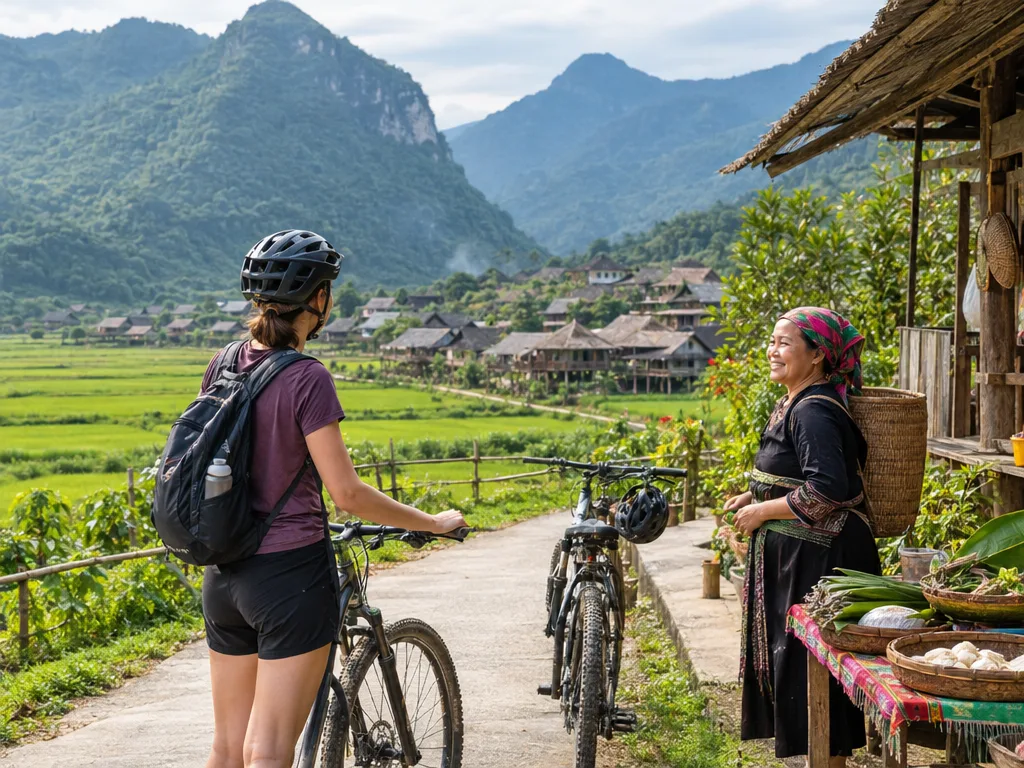
Cycling is one of the most satisfying things to do in Mai Chau because the scenery unfolds at human speed. Quiet ribbons of road and path connect houses, fields and small communities, but surfaces can vary and local traffic still matters. Ask your host to suggest a route for your ability rather than following a generic map blindly. Check brakes, tyres, saddle height and lights before leaving, even for a short ride.
- Leave early for cooler temperatures and softer light.
- Carry water, sun protection and a phone in a waterproof pouch.
- Slow down near homes, livestock, children and blind corners.
- Park only where your host or a resident indicates.
- Return before darkness unless you have reliable lights and local route advice.
The best loop is not necessarily the longest. Stop to look across the paddies, but do so from the edge of a path or a permitted rest point rather than walking into planted fields. If a route crosses a working yard, greet people and wait for a clear invitation before taking photographs. Cycling becomes more respectful when you remember that the valley is a lived-in agricultural landscape, not a scenic backdrop built for visitors.
Walking, viewpoints and gentle outdoor adventure
Mai Chau suits travellers who want movement without committing to a high-altitude trek. Short village walks can be combined with a longer rural outing, but difficulty depends on the exact route, weather and season. Rain can make earth paths slippery; heat can make a seemingly easy climb feel much harder. Wear shoes with grip, carry water and ask a local host about current conditions before setting out.
If your group is choosing between walking and a more demanding adventure elsewhere in the region, A Safer, More Enjoyable Day on a Mountain Trail offers useful preparation principles. For a broader comparison of activity levels, see Outdoor Adventure Activities. Those links are especially useful for mixed groups: one person may want a long walk while another prefers a flat cycle and an unhurried meal.
Do not assume every attractive ridge is a public viewpoint. Some paths pass through private land or working areas, and a local guide may be needed to avoid trespassing or getting lost. Ask before climbing fences, entering yards or photographing ceremonies. A slower route with permission is better than a dramatic shortcut that creates friction.
Food, crafts and cultural etiquette
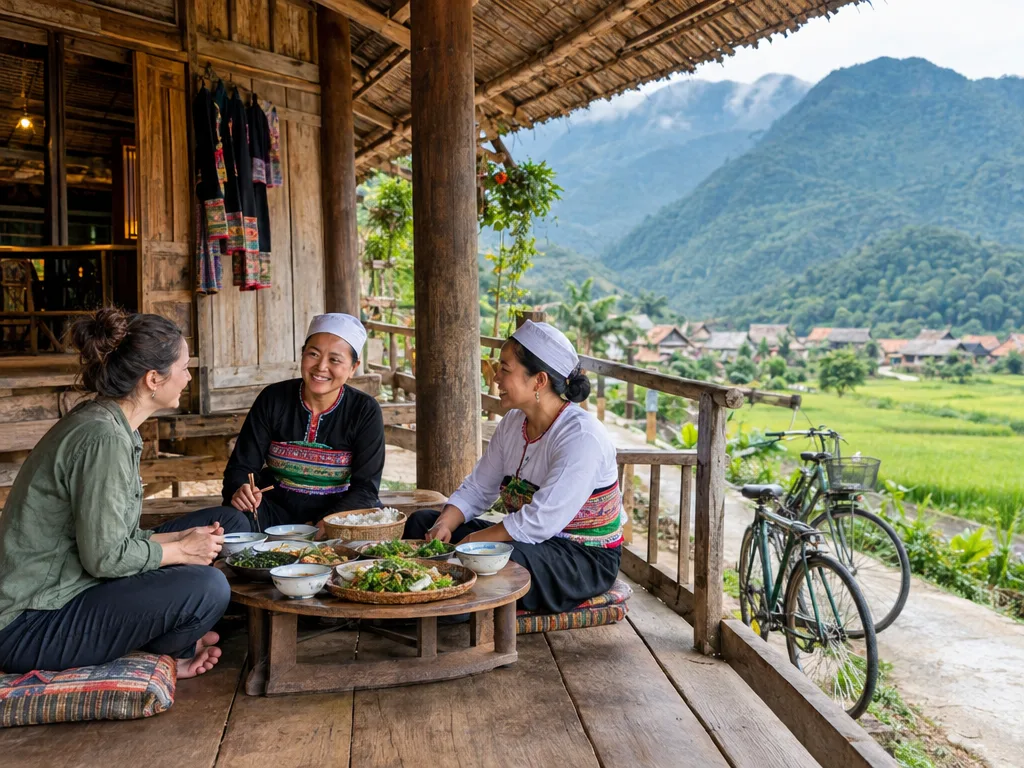
Meals are central to the Mai Chau homestay experience. Hosts may serve rice, vegetables, herbs, grilled or cooked meats and local specialities according to the household and season. Tell your host about allergies and dietary restrictions before the meal, not when food is already on the table. If you are unsure how a shared meal works, watch your host or ask politely. Trying a little is courteous, but you should not feel pressured to finish something you cannot eat.
Handwoven textiles are a meaningful purchase when bought thoughtfully. Look at the work, ask who made it and consider whether the price reflects the time involved. Bargaining should remain gentle and good-natured, not an attempt to reduce a handmade item to the lowest possible number. Bring a reusable bag and avoid buying wildlife products or anything whose origin the seller cannot explain.
Dress modestly around homes and community spaces, keep voices low at night and ask before photographing people. A smile and a greeting go a long way, but friendliness is not permission to enter a house or record a performance. If your visit includes a cultural show, remember that performers are people from the community, not props for close-up photography. These small choices make the stay more comfortable for everyone.
When to visit and how to prepare
Vietnam’s official tourism guidance highlights September to November for cool, clear days and golden rice scenery, while March to May can also be pleasant. It also notes heavier rain from May to September. These are useful patterns, not guarantees. Check the forecast close to departure and keep plans flexible. A rainy day can still work if you replace exposed cycling with a shorter walk, a meal, a craft visit or time at the homestay.
Mai Chau is roughly a road journey from Hanoi rather than a quick city transfer. Confirm your departure point, arrival time, luggage policy and final drop-off before booking transport. If you are travelling onward by motorbike, inspect the route and weather rather than relying on a timetable that may change. The site’s Motorbike & Road Trips category can help you think through road conditions, pacing and responsible riding across northern Vietnam.
- Pack light rain protection even in a generally dry forecast.
- Bring modest clothing for village visits and a light layer for mornings.
- Carry cash for small purchases, while confirming payment options in advance.
- Use refillable water where safe and reduce single-use packaging.
- Keep a flexible plan for rain, heat and delayed road travel.
Travel responsibly in a working valley
Responsible travel in Mai Chau is practical rather than abstract. Stay in locally run accommodation when possible, eat food prepared by the household, and pay fairly for guiding or activities. Ask before using a drone, entering a field or photographing a person. Keep to paths, take rubbish with you and avoid loud music in the evening. If a host asks guests not to use certain areas or water sources, follow that request.
Consider how your spending is distributed. A single large group booking may be convenient, but smaller choices—an extra meal with a host family, a locally guided walk or a purchase directly from a maker—can support more people. Be wary of staged “authenticity” claims and focus on the quality of the interaction rather than collecting proof of it.
For broader principles on visiting rural landscapes and communities, read How to Visit Northern Vietnam’s Wild Places with Care. The same mindset applies here: leave fields undisturbed, avoid litter and let local rules shape your route.
Common planning mistakes to avoid
The first mistake is overloading a short visit with distant stops. Travel time can consume the calm experience you came for. The second is assuming that all homestays offer the same facilities. Ask specific questions about bathrooms, mattresses, meals, noise and transport. The third is treating a cycling route as flat and effortless without checking the surface or weather. The fourth is arriving with no plan for dinner; in a rural setting, hosts may need notice to prepare food.
Another mistake is comparing Mai Chau only with more dramatic destinations. The valley is not trying to be Ha Giang’s mountain road or a high-altitude trekking centre. Its appeal is the balance between access, culture, gentle activity and rural scenery. If that is what your group needs, staying longer in one area may be more rewarding than adding another destination.
Final advice for a memorable Mai Chau stay
Plan a framework, then leave space inside it. Choose a village base that matches your comfort level, reserve enough time for a cycle or walk, and let your host improve the route with local knowledge. Visit during a season that suits your priorities, but accept that weather and farming activity will shape the view. Eat with curiosity, buy crafts fairly and treat every village path as part of someone’s home and livelihood.
Mai Chau Valley experiences are most rewarding when they feel less like a checklist and more like a conversation with a place. Slow down, travel lightly and allow the ordinary details—rice fields, a shaded lane, a shared meal or the sound of a stilt house settling at night—to become the main attraction.

JOIN THE CONVERSATION
Comments (0)
No comments yet. Be the first to share a thought.