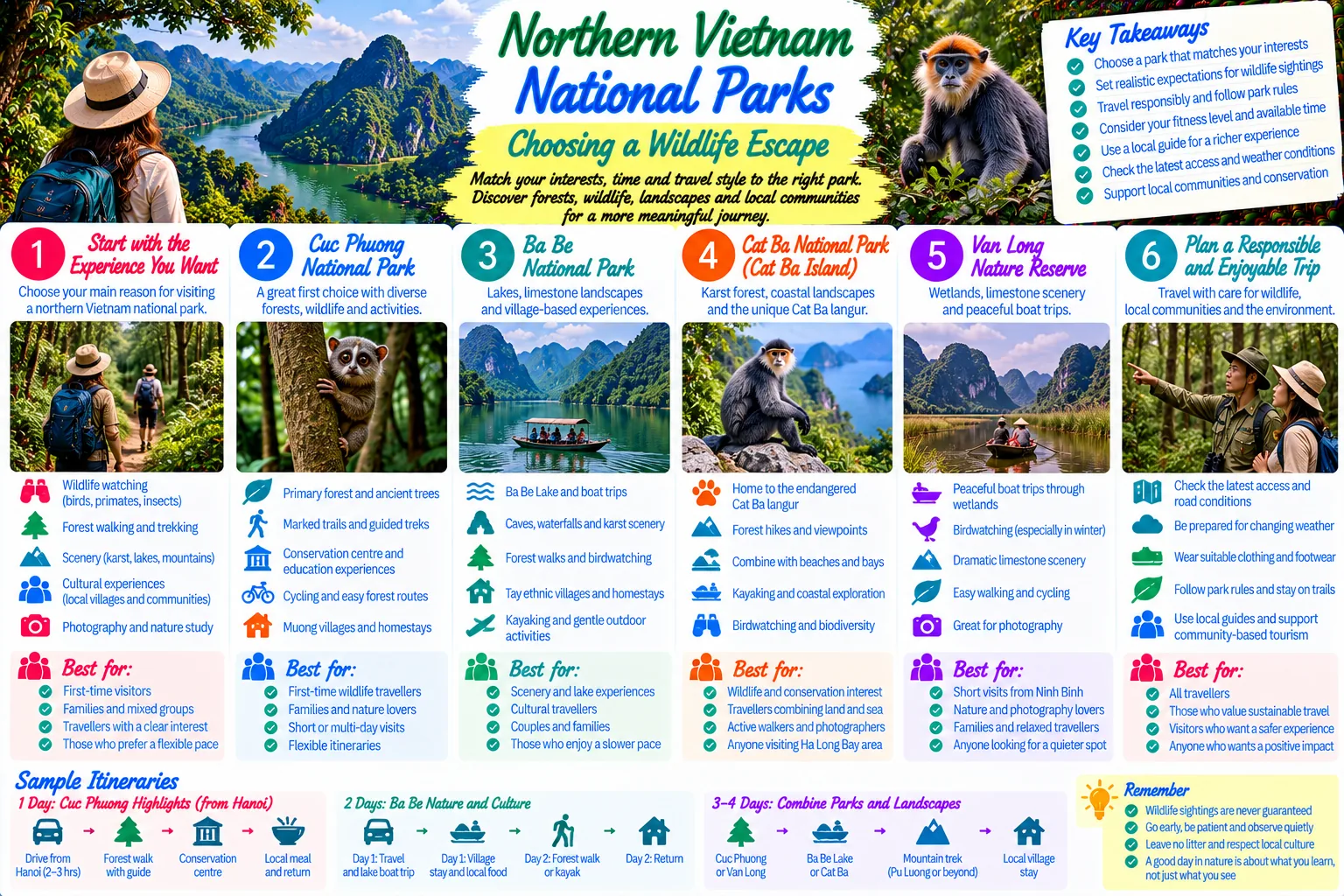
Northern Vietnam national parks are not interchangeable green escapes. One may suit a dawn birdwatcher, another a family that wants a manageable forest outing, and another a traveller who prefers a slow, community-led stay. The best choice depends less on collecting famous names than on matching wildlife interests, walking confidence, available time, and tolerance for uncertain mountain weather.
This guide turns that choice into a practical plan. It explains how to compare northern Vietnam national parks, what a realistic wildlife day looks like, how to travel with less pressure on fragile habitats, and when to choose a park-based trip over a broader mountain itinerary. For a wider introduction to the region, see this first-timer’s guide to Northern Vietnam adventures.
Start with the experience, not the park name
Searches for “best national parks in northern Vietnam” often produce a list, but a list does not tell you which place fits your trip. Begin with the experience you want to repeat for several hours: quiet forest walking, birdwatching, night wildlife, karst scenery, community contact, or a physically demanding trek.
Choose by your main reason for going
For forest variety: look for a park where short trails, longer treks, conservation centres, and different habitat zones can be combined.
For wildlife watching: prioritise early starts, patient observation, a local guide, and realistic expectations rather than a promise of rare-animal sightings.
For scenery: choose a landscape with a strong visual identity, such as limestone, lake, wetland, or high mountain terrain.
For culture: consider a route that connects protected landscapes with villages and locally run accommodation.
This approach also helps separate a national-park visit from a general adventure itinerary. The site’s National Parks & Wildlife category is the natural place to compare conservation-led ideas, while the Mountain Trekking & Hiking category is more useful when the walk itself is the main objective.
Why Cuc Phuong works for a first wildlife-focused trip
Cuc Phuong National Park is a useful model for planning because its official tourism information presents more than one way to experience the forest. Visitors can trek in primary forest, follow marked trails towards ancient trees, caves, and Muong villages, or arrange longer walks and overnight options. The same source recommends a guided tour when travellers want more information from a short or long trek.
That range makes Cuc Phuong especially suitable for travellers who want flexibility. A short visit can combine a forest walk with a conservation-focused stop. A longer visit can add village-based experiences, cycling, night-spotting, or birdwatching. The park’s official activity page also describes opportunities to look for amphibians, insects, reptiles, and tropical plants, so the experience is not limited to hoping for a large mammal.
Build a realistic Cuc Phuong day
Start early, when temperatures are more comfortable and bird activity is more likely. Use the first part of the day for a guided or clearly planned trail rather than trying to cover every attraction. Allow time to stop quietly; a rushed walk turns a wildlife habitat into scenery viewed through a timetable. In the afternoon, choose one complementary activity, such as a conservation education visit, cycling, or a shorter forest route.
Do not treat the park’s activity list as a guarantee. Seeing a loris, pangolin, flying squirrel, or rare bird depends on season, weather, habitat, noise, and luck. A good day can still mean learning to identify calls, noticing insects on a leaf, or understanding why rescued wildlife cannot simply be returned to any forest.
Match park choice to trip length
If you have one day
Choose one main landscape and one supporting activity. A single forest walk, a conservation visit, and an unhurried meal are more satisfying than a chain of distant stops. Confirm the route and current access arrangements before leaving, because official information can age and road conditions can change.
If you have two or three days
You can slow down enough to include a dawn outing, a second habitat or trail, and a community-based experience. This is where a park begins to feel like a place rather than a checklist. If you are adding a village stay, ask who hosts it, how the visit benefits residents, and which activities are appropriate for the season.
If you have a week
Link one park with a contrasting region instead of repeating similar forest days. For example, combine a lowland or limestone park with a mountain trek, a valley walk, or a road journey. The site’s guide to a gentle nature escape in Pu Luong can help you think about a slower, village-and-landscape extension rather than adding another demanding summit.
Plan the practical journey without inventing certainty
Travel time is part of the park decision. Cuc Phuong’s official access page places the park about 120 kilometres from Hanoi and describes a typical drive of roughly two to three hours, depending on transport. It also notes that the approach from Nho Quan has been subject to road upgrading, which is a reminder to check current conditions rather than copying an old timetable into your plan.
The same page describes routes through Ninh Binh and local onward transport from Nho Quan, but its bus details are dated on the page. Treat them as leads for verification, not as guaranteed current departures. Before travelling, confirm the latest road status, departure point, vehicle availability, and last return option with the park, a reputable accommodation provider, or a current transport source.
For independent travellers, leave a margin for delays and avoid arranging the final connection so tightly that a late bus or rain turns into a safety problem. If you are riding a motorbike, daylight, weather, road surface, and your own experience matter more than the shortest route. Read this responsible Northern Vietnam road-trip guide before treating a park visit as a simple detour.
Use guides and conservation centres well
A guide is not just a way to walk faster. In a forest, a knowledgeable guide can help you pause at the right places, interpret tracks and calls, explain local plants, and keep the group from drifting into sensitive areas. Ask what the walk involves, how long it lasts, what footwear is sensible, and whether the route is suitable after heavy rain.
Conservation centres can add meaning when visitors approach them as education rather than entertainment. At Cuc Phuong, the official tourism page describes a carnivore and pangolin education centre where visitors can learn about rescued animals, threatened species, hunting traps, footprints, and calls. Listen to the rescue stories, follow photography rules, and do not frame an animal’s captivity as a guaranteed viewing success.
Questions worth asking before booking
Is the activity led by park staff, a trained local guide, or a general driver?
Does the fee support the park, a conservation programme, or a community host?
What happens if rain, heat, flooding, or trail damage changes the route?
Are night walks permitted, and what behaviour is expected?
Can the operator explain wildlife welfare and photography boundaries?
Wildlife etiquette that improves the experience
Wildlife watching is a practice of reducing disturbance. Keep voices low, stay on permitted paths, and do not surround an animal to obtain a photograph. Never feed wildlife, use playback calls, shine bright lights directly at animals, or touch wild creatures. If a guide asks the group to move on, accept that instruction even when a sighting feels rare.
Pack reusable water and carry every piece of rubbish out. Avoid single-use items where practical, but do not sacrifice safe hydration to appear minimalist. Wear muted, comfortable clothing, protect yourself from sun and rain, and bring only equipment you can use quietly. Binoculars are often more valuable than a long lens because they let you observe from a respectful distance.
Responsible travel also includes social behaviour. Ask before photographing residents, homes, ceremonies, or children. Pay fairly for guiding and homestay services, follow household rules, and remember that a village is a lived-in community, not a themed attraction. If you want more general advice on low-impact visits, the existing article How to Visit Northern Vietnam’s Wild Places with Care is a useful companion.
Weather, fitness, and expectations
Northern Vietnam’s parks can feel very different across the year. Heat, humidity, rain, muddy ground, mist, and cool mornings all change the quality of a walk. Instead of chasing one supposedly perfect month, choose the conditions you can handle and build flexibility into the itinerary. A wet forest may be beautiful but slower; a hot afternoon may make a short trail feel strenuous.
Fitness planning should be specific. Ask about distance, steep sections, slippery ground, stream crossings, stairs, and return options. A traveller who is comfortable walking in a city may still prefer a short forest loop, while an experienced hiker may enjoy an overnight route but need a guide and proper local arrangements. If the group has mixed abilities, plan a shared core activity with optional extensions rather than forcing everyone onto the same long trail.
Pack for observation, not just movement
A good national-park packing list is deliberately modest. Bring footwear with dependable grip, light layers, rain protection, sun protection, a refillable bottle, insect protection, and a small dry bag for electronics. Add binoculars if wildlife is central to the trip, but do not let camera equipment dictate the route or encourage you to approach animals too closely.
Carry a simple offline note of your accommodation, meeting point, emergency contact, and planned return time. Keep copies of essential documents secure, and tell someone outside the group where you expect to be. For overnight or remote routes, ask the guide what food, bedding, lighting, and first-aid provisions are actually included rather than assuming that a package covers every need.
A simple decision framework
Before booking, score each possible park from one to five for five questions: travel time, walking fit, wildlife interest, cultural interest, and weather flexibility. Then write down the one thing that would make the day successful even if no rare animal appears. This prevents a single uncertain outcome from controlling the whole trip.
For many visitors, the strongest plan is not the park with the longest attraction list. It is the place where the route, guide, season, and group energy line up. Choose fewer activities, allow space for observation, and verify current logistics close to departure. That combination creates a wildlife trip that feels both adventurous and considerate.
Conclusion
Northern Vietnam national parks reward patience more than speed. Choose by the kind of nature experience you want, use official guidance as a starting point rather than a timeless timetable, and treat conservation, communities, and wildlife as part of the journey itself. With a realistic route and respectful expectations, even a short park visit can become one of the most memorable days in northern Vietnam.
JOIN THE CONVERSATION
Comments (0)
No comments yet. Be the first to share a thought.